Recap: Sundance Collab Week 8.

Hello, my fellow artists! I am recapping my weekly experiences of the writing course I’m taking at the Sundance Collab. These recaps are a cool insight into the creative process and personal journey of building something from scratch. In this case, a feature film treatment.

Recap: Week 8. The moment has finally arrived! The whole goal of this course was to take an idea for a feature film and create a fully-realized treatment for it. This was the week to start transitioning into this final phase! Wow! I expanded from an idea to an action summary to a beat sheet to an expanded beat sheet to an outline, and now, to the beginning of a treatment. This has been an amazing and crazy ride. Seeing my story expand over the last 8 weeks is a wonderful feeling and accomplishment. I’m so proud of myself. One more week to go! Keep reading below 🙂

A treatment is where you now infuse emotions into your scenes. If you remember from last week, an outline is an expanded breakdown of what is happening from one scene to the next. Now, in terms of a treatment, “what do the characters feel when these things are happening? The treatment is an emotional short story. From scene to scene, what is this scene about? And then fill it out emotionally.” Our goal in this course is to create a treatment that is 10 to 15 pages long. And the purpose and power of a treatment is that it is the source material for our eventual screenplay. The treatment will guide us in the actual writing of our feature film screenplay. It takes the guesswork out of our writing. Keep reading below 🙂

Armed with my course advisor’s notes from last week and the answers I came up with, I meticulously went through as many scenes as possible and asked myself, “what is this scene about?” and “what is this character(s) feeling?” “When and how will Luke’s assets and liabilities that I created in week two show up in these scenes?” “Is the theme of my movie, which I discovered in week one, present within this treatment? When does the theme come up and how often does it come up?” “Is Luke’s emotional drive clearly coming through in my scenes?” Some scenes were easier than others in terms of discovering what they were about and my ability to fill them out emotionally. However, I know that if I keep going back to those other scenes and ask the next question, the answers will present themselves. Or, I’ll realize that those scenes don’t work. In which case, I can get rid of them (and I’ve already gotten rid of a few scenes that didn’t fit within my story.) I made it to the beginning of act two and realized I was going to need more time to continue tackling the rest of my scenes LOL. LOL. LOL. Keep reading below 🙂

With one more week to go, I have a feeling that we will be able to continue tackling our treatment. See you all next week for the FINAL recap of my Sundance Collab writing course experience!

Recap: Sundance Collab Week 7.

Hello, my fellow artists! I am recapping my weekly experiences of the writing course I’m taking at the Sundance Collab. These recaps are a cool insight into the creative process and personal journey of building something from scratch. In this case, a feature film treatment.

Recap: Week 7. We are almost nearing the end of the journey. Two more weeks to go! And once this course is over, I’ll be blogging about my acting endeavors, plus my 2nd & 3rd quarter wins! Keep reading below 🙂

Week 7 was all about taking our expanded beat sheet from last week and moving it towards an outline. An outline is where we start expanding upon the one-liner sentences from our beat sheet. We add details as we march towards the final goal of creating a feature film treatment. One way to add details is to think about the visuals of the film. Film is a visual medium. How can we utilize visuals to tell our story and reveal the emotional inner life of our characters? There’s that famous expression that goes, “A picture is worth a thousand words.” So that as you read my treatment, and eventually, my screenplay, you can SEE the movie in your mind. You can see and FEEL what’s happening from one page to the next. Keep reading below 🙂

It was great to comb through my expanded beat sheet and think about how to infuse visuals into my scenes. I used a blue font to add the visual components. And from using the blue font, I could see (pun intended) how my scenes expanded. Keep reading below 🙂

Once I added visuals, the next step was to go through the beat sheet again to continue adding more details about what is happening from scene to scene. This beat sheet, now called an outline, could be expanded up to 8 pages. I got to 7 1/2 pages and submitted it to my course advisor. Overall, she thinks I’m off to a great start and that I have a great idea for my feature film. She provided wonderful comments and questions throughout my outline to help me take my story to the next level. She asked the next question and came from a place of support. I let her feedback sit with me for a few days because I wanted to give myself time to let the answers come to me. And then, I received the weekly email from my Thursday scene study class that contained the inspirational quote of the week. That quote unlocked something within me! An “a-ha” moment! I sat down at my computer and answered all but two of her questions. Now, I have to implement these answers into my outline and keep carving them out. Keep reading below 🙂

Fun fact: I am writing a feature film with a friend and colleague of mine for our Professional Development Program 3.0 class, and I could see how week 7 immediately influenced the scenes I recently wrote. Keep reading below 🙂

Until next week!

Recap: Sundance Collab Week 6.

Hello, my fellow artists! I am recapping my weekly experiences of the writing course I’m taking at the Sundance Collab. These recaps are a cool insight into the creative process and personal journey of building something from scratch. In this case, a feature film treatment.

Recap: Week 6. This week, we were challenged to expand upon the beat sheet that we created last week. To help us expand our beat sheet, we were introduced to the “index card method.” This method was really cool because it reminded me of a method I use when I prepare for an audition. (For my fellow Richard Lawson Studios colleagues who have taken the Professional Development Program, you’ll figure it out as soon as I describe the index card method further.) Keep reading below 🙂

Take a stack of index cards and write down every scene from your beat sheet onto them. Once you are done, put them up on your wall in chronological order from left to right. (My fellow RLS peeps, does this ring a bell yet?) Once the index cards are up on your wall, read through what you have. This visual story on the wall helps you see what scenes you have and what scenes you don’t have. By seeing what scenes you have and don’t have, you can start filling in the blanks to expand your story. Having your story up on the wall helps you to see it in a clearer way versus seeing it on your computer. The story is out in front of you. Keep reading below 🙂

As I read the index cards each time through, a new scene occurred to me because I saw and understood my story a little bit more. Great! I wrote that new scene on a blank index card and placed it on the wall. (My RLS peeps, are you getting warmer?) Keep reading below 🙂

We were also encouraged to color code our scenes so that the main storyline was in one color and the B storyline in another. By utilizing colors, we can see how balanced our story is or how one note it is. For example, I realized that my B storyline was lacking in act 2. I also realized that act 2 needed more scenes in general! The other aspect of the index card method that I like is that you can move the cards around to make certain scenes track better, or take them out if they don’t work. Rearranging certain scenes or removing them helps to create clarity for your story. Seeing my index cards on the wall was so awesome, and I had fun reading through my story repeatedly and adding, moving, and removing scenes. Keep reading below 🙂

Okay, okay! My RLS community has to know by now what the index card method sounds like………………………THE SUBTEES PROCESS! The Subtees Process is a method we use in our audition preparation to discover the subtext of our character. Film acting is about subtext. It’s about what you don’t say. The first step of the Subtees Process is to write the entire audition scene on one stack of Super Sticky Post-it Notes before you transfer them to the wall, top to bottom, left to right. And through an extensive series of steps where you utilize different-colored Post-it Notes, you create and build a character from scratch, infusing them with history, light and dark subtext, the moment before, etc. And each time you go through the Subtees Process, you gain more clarity about your character and the scene. And the power of this process is that if I were to look at your wall and go through it, I could also perform the character. Why? Because the Subtees Process is a blueprint, an architectural design, that guides you on how to play this character. Once I expanded my story on the wall, I added those new scenes to the beat sheet on my computer. Keep reading below 🙂

The next step was to use the “sequence method” to continue expanding my beat sheet. I like the sequence method because it breaks down the three act structure into these smaller sections, or “manageable chunks”, that are like these mini stories. And each sequence serves a specific purpose or function to move the story forward. It’s a more gradient approach where I can tackle my story one sequence or chunk at a time. I can see what needs to happen in one sequence before I can transition into the next. I went back to my wall and rearranged my scenes into these sequences. The sequence method gave me more clarity. It helped me to see where the holes in my story were. For example, I realized I needed a little more set up in act 1 to propel my protagonist into act 2. I realized that the scene I thought was my act 2 climax was incorrect and that it was actually the one after it. I also had to make sure that not only did my scenes create a beginning, middle, and end within each sequence, they also had to fulfill the purpose of each particular sequence. So I ended up creating more scenes to add to my beat sheet. Keep reading below 🙂

See you all next week!

Recap: Sundance Collab Week 5.

Hello, my fellow artists! I am recapping my weekly experiences of the writing course I’m taking at the Sundance Collab. These recaps are a cool insight into the creative process and personal journey of building something from scratch. In this case, a feature film treatment.

Recap: Week 5. Let’s jump right in! I haven’t experienced impostor syndrome yet, so that’s good! We’ve studied films like “You Can Count On Me” and “Sideways” in the last couple of weeks. I have also been thinking a lot about my story while in the shower, while on the toilet, and while trying to go to sleep. Keep reading below 🙂

This week, we focused on the three act structure and creating a beat sheet. Once again, I was glad I understood the three act structure and its components due to my previous work with “My Story Can Beat Up Your Story”. Last week, I submitted my action summary to my advisor for feedback. Now, it was time to take that action summary and extract sections that fulfilled the major components of the three act structure. So far, so good: My action summary contained the components of the three act structure, and I plugged them in (e.g. the inciting incident, the midpoint of act two, the act two climax, etc.) Keep reading below 🙂

Once I did that, it was now time to tackle the beat sheet. And you might be asking yourself: What’s the difference between the three act structure and the beat sheet? The way I look at it is that the three act structure is like the major overview of your story. Kind of like the skeleton of your story. This structure contains these major moments you need to have and hit in your story, whereas the beat sheet is the beginning of the scene by scene breakdown of your story. This is where you start filling in scenes across the three acts. Keep reading below 🙂

So, I went from this major overview of my story to the scene by scene breakdown of it. And like my instructor said, “the beat sheet isn’t pretty. It’s an outline of an outline. But each short scene description should march you through the basic building blocks of those three acts.” The beat sheet can be rough and crude. All I need to do right now is write one-liner scenes that take my story from beginning to end. For example, I wrote, “Luke runs down the streets of Brooklyn with a bag of chips in his hands.” “Luke goes home and interacts with his mother and brother.” “Luke flies to LA to start training.” “They kiss.” That’s it LOL. There were some scenes where I added more details, but I loved and enjoyed the freedom of these one-liners. It took the pressure off of feeling like 1) I needed to know every single scene that occurs in my movie (which I don’t!) and 2) that I had to describe every single scene in detail (which I can’t…yet!) I know more scenes will come to me as I keep looking at my story, and I’m pretty sure we will get to the details in a future class LOL. Keep reading below 🙂

My story is growing and taking shape! Until next week!

Recap: Sundance Collab Week 4.

Hello, my fellow artists! I am recapping my weekly experiences of the writing course I’m taking at the Sundance Collab. These recaps are a cool insight into the creative process and personal journey of building something from scratch. In this case, a feature film treatment.

Recap: Week 4. Last week, I shared how my causative routine was going, plus the creation and exploration of the other characters in my feature film. This week’s class was exciting because it focused on the overall arc of our story. What’s our story about from beginning to end? Also, how do the characters drive the story forward? Our homework was to write a one-to-two page summary of our story. The basic beginning, middle, and end. Keep reading below 🙂

Woo hoo! Here was an opportunity to tell my story from beginning to end. Here was an opportunity to see if my idea could go the distance from fade in to fade out. Let’s do this! The homework also confirmed what I learned in class: Each new generation consumes more and more stories via film, television, and streaming, and so most people today inherently have a strong sense of storytelling. I share that because I was pleasantly surprised at how much story poured out of me when I sat down to type. I understood the overall framework and arc of my story. I knew where it started and where it ended. When I finished, I had written several pages worth of my summary LOL. Good problem to have because I can always edit it down. I can always cut the cloth shorter. Keep reading below 🙂

While editing, I kept telling myself to focus on the main points. Describe more succinctly. Don’t be precious with every word. Get it down to one to two pages. I finally did and sent it over to my advisor for feedback. I felt accomplished. I felt like I did my best. She said I did a great job and that she loves a sports story. She also asked me a couple of questions regarding my story and to make sure that the emotional drive for my character is coming through. Her feedback and questions were helpful and they inspired me to continue looking at my story and ask more questions. Keep reading below 🙂

See you all next week when I recap week five! (Oh yeah, ever since this course began, I’ve also been doing extra research outside of class that will help me out when I eventually write my feature film script.)

Recap: Sundance Collab Week 2.

Hello, my fellow artists! I am recapping my weekly experiences of the writing course I’m taking at the Sundance Collab. These recaps are a cool insight into the creative process and personal journey of building something from scratch. In this case, a feature film treatment.

Recap: Week 2. This week was a testament and confirmation of what I talked about last week in terms of asking the next question. Week 2 was all about the creation of my main protagonist! My hero! The person the audience will follow and root for from beginning to end. There were three homework assignments for this week. The first homework assignment contained 29 questions to help me create my character and understand who this person is. At first, I was like WTF at some of the questions, but I realized that each question (and answer) painted more of my protagonist’s picture. I discovered things about my character that I would not have thought about or considered if it wasn’t for these questions. And I realized that a few of these discoveries will make their way into my script as dialogue and moments (I see what you’re doing there, Sundance!) The second and third homework assignments continued with the exploration of my protagonist. Some of these things will also make their way into my script. Keep reading below 🙂

I also created a causative routine that set me up for success. I will continue to utilize this routine each week because there’s a lot of homework. I know which day I start my homework, and I use the WHOLE week to carve it out. As I mentioned last week, I took the pressure off myself to have all the answers in one day. Having a routine allows me and my work to breathe. Each day provides an opportunity to know more and push my work further. I gain greater insight into what I’m creating through my causative routine. When I finish my homework for the week, I feel like I have done my best. And just as important, my causative routine keeps me SANE because I’m not scrambling or cramming to get it all in. Keep reading below 🙂

Outside of the assigned homework, I also did research to find real-life prototypes for my protagonist in terms of images and interviews. This research helped me to see and hear my character in three-dimensional form. And in turn, this research informed my homework. I also realized that I suck at creating character names LOL. It’s the reason why I recycle the same names in my writing work LOL. I somewhat agonized over finding names for my protagonist (and the other characters in their universe.) I had to remind myself of the importance of placeholders. Don’t get precious. Pick a name and move on. I can always change them later once I learn more about my characters. Or not. Perhaps Luke is the best name for my protagonist. I mean, names are important, right? It’s a part of their identity. Right? I’m going to be dedicating my entire life to these characters, so I gotta love their names, right? Right? RIGHT? LOL. See you all next week for a recap of week 3!

My Major Revelation About Career Policies!

Hello fellow artists! Here’s to another week of moving my acting and writing careers forward. My goals for this year are to continue booking theatrical and commercial work and to sign with a new literary agent. These goals are tied to a larger postulate of mine within my DOIN (Declaration of Independence aka business plan.)

As I pursue these goals, it’s important that I have policies in place. With any business, policies are essential to keep it running and operating on a high level. Policies keep it afloat and on track to achieving their various short-term and long-term goals. Here’s the definition of policy: a definite course of action adopted for the sake of expediency, facility, etc. a document embodying a contract of insurance. I’ve always understood this definition on an intellectual level and have had various degrees of success with implementing policies to keep my business (aka Jorge Ortiz Inc.) alive, healthy, and on track. Keep reading below 🙂

At the beginning of each year, I create a postulate DOIN for that year (A sub-DOIN from my main DOIN, if you will.) It’s a way for me to choose one postulate from the list and focus on it for the year. When I got to the policies section, I couldn’t help but feel uninspired and disconnected from what was there the year before. I had several policies listed that I wasn’t executing or honoring. These policies weren’t a contract of insurance. They weren’t things I had to do. Let alone, I didn’t even understand why I had to do them. For example, consume at least 50% organic food every day. Okay, I love organic food. I like being healthy. But WHY is this a policy? How is this policy connected to WHAT I’m trying to achieve as an artist? Why is this policy here in my DOIN? Keep reading below 🙂

And then, I had a major revelation. I realized that policies are connected to a specific postulate! BOOM! I am on a journey to achieve a postulate. A postulate sits at the very top of the mountain. So, what policies do I need to establish to help me get there? BOOM! It all made so much sense to me. Of course! Armed with this revelation, I identified five policies that I felt would support my journey towards my postulate. I understood the WHY behind these policies. I understood WHY I needed to do them. These five are enough for now. If I add a few more arbitrarily, I will set myself up for disappointment. I need doable, tangible, executable policies that SERVE my postulate. Below, please see the postulate I’m focusing on for this year and the five policies attached to it. Keep reading below 🙂

Postulate: I am one of the top, consistently working, bankable, and respected actors, writers, & executive producers in Hollywood. Keep reading below 🙂

  1. Execute at least one item of career administration Monday through Friday. Administration means the actions I’m taking to achieve my acting and writing goals. I know when to execute these actions each day. I know what these actions will consist of because I pull them from the administration plans written within my DOIN (On Sundays, I look over my DOIN and write out my administration for the week in my calendar.)
  2. Use social media as a platform to engage with others and to share about myself at least once on Mondays, Wednesdays, Fridays, and Sundays. Pretty self-explanatory! I’m consistent about the times I post on social media and what exactly I post on it.
  3. Practice and memorize sides once a week. I know which day of the week I do this on. This is important to keep my mind sharp.
  4. Return communications within 24 hrs. In terms of how I want to be seen and respected in this industry, this is a must.
  5. Take Lion’s Mane Mushroom supplements every morning at 8am. Healthy brain regiment so that I can operate at the highest level possible as an actor and writer. Keep reading below 🙂

Those are my policies! And here’s the other thing that I realized about the power of policies. For the last two weeks, I’ve felt somewhat uninspired and discouraged. I felt like I wasn’t accomplishing anything. And then I remembered what Richard Lawson once said about policies: “If you don’t do your policies, you take a loss on them…Policies also determine the quality of the trip and the consistency of it. These things help to sustain the effort of the trip when they are applied, and when you start breaking policies–policies are directly connected to statistics. If you keep statistics of certain things, you will notice that your statistics will drop when your policies deteriorate.Keep reading below 🙂

Of course! I fell off my policies for the last two weeks. That’s why I felt uninspired. My administration statistics went down because I got off track with my policies. DUH! That being said, the beauty of this is that I can quickly get back on my policies. (My apologies to anyone if I didn’t return communications to you within 24 hours over these last two weeks!) Keep reading below 🙂

What policies are keeping you on track towards your dreams? Let me know in the comments section below!

Time To Recap My 2023 Blog Entries!

Hello fellow artists! I wanted to take this opportunity to recap all of the blog entries I’ve done so far in 2023. Why? Because Chasing The George is about the journey I’m on to carve out the career I want as an actor and writer, and this is a cool way for everyone to catch up or revisit past entries that document and reveal this pursuit. And personally, I get to see where I was when the year started, where I am now, and where I need to go next. From my celebrity friends dispensing practical advice to taking headshots to being back in class to what to do during the writers’ strike, I’ve listed them all in chronological order:

The Journey Continues: https://chasingthegeorge.com/2023/02/12/the-journey-continues/ Keep reading below 🙂

Advice From My Celebrity Friends: https://chasingthegeorge.com/2023/02/19/advice-from-my-celebrity-friends/ Keep reading below 🙂

One Of The Best Meetings I Didn’t Win: https://chasingthegeorge.com/2023/02/26/one-of-the-best-meetings-i-didnt-win/ Keep reading below 🙂

A Road To Taking Headshots: https://chasingthegeorge.com/2023/03/05/a-road-to-taking-headshots/ Keep reading below 🙂

It’s The Little Things That Count: https://chasingthegeorge.com/2023/03/12/its-the-little-things-that-count/ Keep reading below 🙂

7 Story Ideas in 7 Days. Part 1: https://chasingthegeorge.com/2023/03/19/7-story-ideas-in-7-days-part-1/ Keep reading below 🙂

7 Story Ideas in 7 Days. Part 2: https://chasingthegeorge.com/2023/03/26/7-story-ideas-in-7-days-part-2/ Keep reading below 🙂

The Final Chapter: 7 Story Ideas in 7 Days: https://chasingthegeorge.com/2023/04/02/the-final-chapter-7-story-ideas-in-7-days/ Keep reading below 🙂

What Are Your 1st Quarter Wins: https://chasingthegeorge.com/2023/04/08/what-are-your-1st-quarter-wins/ Keep reading below 🙂

What To Do If The Writers Strike: https://chasingthegeorge.com/2023/04/16/what-to-do-if-the-writers-strike/ Keep reading below 🙂

What Is Your Artistic Reason For Existence: https://chasingthegeorge.com/2023/04/23/what-is-your-artistic-reason-for-existence/ Keep reading below 🙂

Like A Virgin (Again) https://chasingthegeorge.com/2023/04/30/like-a-virgin-again/ Keep reading below 🙂

A Song & Dance Creates The Keys To My Success: https://chasingthegeorge.com/2023/05/07/a-song-dance-creates-the-keys-to-my-success/ Keep reading below 🙂

Writers Strike: FAQs Answered By SAG-AFTRA: https://chasingthegeorge.com/2023/05/14/writers-strike-faqs-answered-by-sag-aftra/ Keep reading below 🙂

Let’s Get Personal (Monologue) https://chasingthegeorge.com/2023/05/21/lets-get-personal-monologue/ Keep reading below 🙂

My (Unholy) Improvisation In Class: https://chasingthegeorge.com/2023/05/27/my-unholy-improvisation-in-class/ Keep reading below 🙂

How I Celebrated My Recent Wins: https://chasingthegeorge.com/2023/06/04/how-i-celebrated-my-recent-wins/

How I Celebrated My Recent Wins!

Celebration is one of the cornerstones at the Richard Lawson Studios. As a student and teacher there, I understand the importance of it. A celebration means to observe (a day or event) with ceremonies of respect, festivity, or rejoicing. Why is celebration important? Because, hopefully, whatever dream you are pursuing, you are doing so for the long run. And as you embark on this journey and continue on it, it’s vital to mark your wins and achievements through celebration. A celebration cements the work you are doing. It’s a pat on the back that reminds you that you have accomplished something and moved forward in your journey. It’s a ceremony of respect for yourself. Look, it can be easy to give up and quit. We can get so focused on what’s ahead that we forget to acknowledge all the steps we have taken. When we do that, we lose perspective. Celebration is your moment to check in, realize what a great job you have done, and stay in gratitude so that you can tackle the next steps of your journey with more energy, confidence, and enthusiasm. Keep reading below 🙂

Celebrations come in all sizes, and you get to decide what celebration goes with which win you have. Celebrations should be personal and specific to you. Something that you really give to yourself. I love being in my office and seeing various celebrations either on my wall in the form of paintings or on my desk in the form of cool ballpoint pens and coloring books. My DOIN (Declaration of Independence aka my business plan) contains a list of diverse celebrations. It’s almost like a menu: I get to open it and pick a celebration for my wins. And celebrations don’t have to cost you an arm and a leg, by the way. They can be free. Keep reading below 🙂

Below are pictures of the celebrations I recently gave myself for a series of wins I’ve had in my scene study class. I purchased a lovely ballpoint pen by Parker to feel like the executive I am. I also acquired a fabulous 8×10 work on paper from a contemporary artist I follow on Instagram named Braxton J. Fuller. He is based in Kansas City and recently mailed the work on paper to me. Check out his exciting, visceral, and thought-provoking work at: https://www.instagram.com/braxtonjfuller/ Keep reading below 🙂

Here are the pictures of my celebrations:

AND OMG! When I received the above work on paper on June 3rd, Braxton included a surprise: Another 8×10 work on paper! I am still so blown away by this unexpected gift! That was really thoughtful of him to do that. And I love this work on paper too. See below 🙂

My (Unholy) Improvisation In Class.

On May 25th, 2023, I completed the fourth and final exercise that is required for returning students of the Richard Lawson Studios. This exercise was an Improvisation. After re-reading the chapter in “Acting Class: Take a Seat”, I knew that I wanted to focus on being moment to moment, to play what was in front of me, and to “discover each moment anew, fresh, using their imagination, without preconception or roadmap or censorship.” In other words, to not be driven by a blueprint and just allowing the scene to occur.

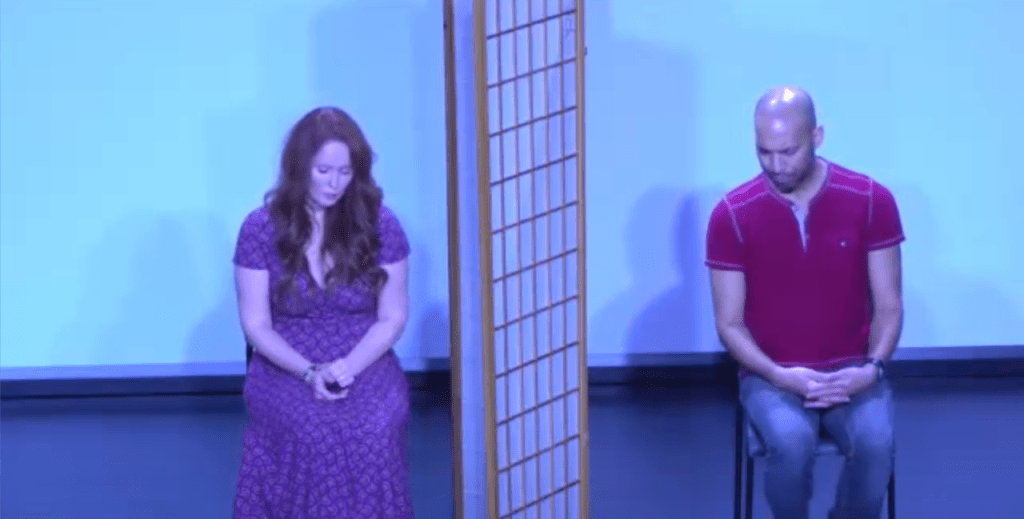
I had a blast with the Improvisation! And what made this exercise so special was that this was the first time I worked opposite another actor on stage since being back in class. Kelly Tighe taught that evening and she called me and my fellow actor (Jayne Marin) up onto the stage. The stage was already set up with a foldable partition in the center and two chairs that were placed on either side of it. Kelly walked up to me and secretly gave me my prompt for the exercise. She said that I was a priest at a confessional booth. Ah! Now I understood the setup on stage. Kelly went over to Jayne and secretly gave her a prompt as well. Jayne and I took our seats, the lights went down, the stage manager called the exercise, and the lights came back on. Keep reading below 🙂

And as the scene progressed in a patient, moment to moment way, I soon discovered that this married woman, who was confessing her strong desire and attraction for someone else, was actually talking about me. I was the object of her desire and attraction. And through her strong yes and my strong no, we created tension and humor. We created an Abbott and Costello. We created an experience where we impinged each other. We had a clear event and there was so much trust between Jayne and I. The scene ended with us kissing passionately and getting ready to make love. I had finally given in to her energy. I had finally given in to her. Keep reading below 🙂

Kelly opened it up to the class for comments about our work. I also asked for casting ideas and received quite a number of great suggestions. I’m grateful for the work I’ve been able to create through these four exercises over the last five weeks (Environmental With A Crisis, Song & Dance, Personal Monologue, and Improvisation.) I feel like I am placing my artistic stamp on the work and allowing myself to continue failing forward so that I can grow as an artist. And to also have joy and fun in the process! The next stop…SCENE WORK! Keep reading below 🙂