Recap: Sundance Collab Week 1.

Hello artists! As mentioned last week, I got accepted into a screenwriting course at the Sundance Collab. This course will help me take an idea for a feature film and create a fully realised treatment for it. Also, as mentioned last week, I am recapping and sharing my personal experiences each week as I build a feature film treatment from scratch.

Recap: Week 1. Two things I wanted to share. 1) Everything really boils down to, “What is this about?” Whether I’m doing a scene in acting class or writing a movie, it’s all about understanding what something is about. That’s the driving force that helps paint the picture (or write the script, in this case) and informs the choices we make. Keep reading below 🙂

2) I also told myself to take the pressure off. Looking at the homework for week one, I felt I needed all the answers to everything in one day. For example, I felt like I needed to clearly and expertly articulate what my movie was about in one day. And when I couldn’t, I started to have a little doubt. “Uh oh, what did I get myself into? Perhaps this is a stupid idea for a movie.” I had to handle myself to remove this pressure and doubt. Once I did that, I allowed my training to kick in. I said that I have to be okay and comfortable with the unknown. I’m starting a journey from scratch. Don’t be afraid of the unknown. Why? Because I can ask the next question. I asked the first question that came to me. Great! I now had either a placeholder or a definitive answer. And from there, I kept asking the next question. Each placeholder or definitive answer allowed me to take another step forward. Each answer provided more clarity. I allowed myself to be patient with the homework and to let the answers come to me. I did what I could to fill in the blanks each day. As the days in week one progressed, I started thinking about other movies and art forms that could help me shape and articulate my answers. I also got on my feet, walked around, and attempted to answer my questions. By the end of the week, I finally arrived at an “a-ha” moment. I knew what my story was about. Keep reading below 🙂

Ask the next question no matter what it is: rehearsals for a scene, an audition, a script you’re writing, etc. See you all next week for my week two recap on developing the protagonist!

My Acceptance Into Sundance Collab!

Hello, fellow artists! I applied for a feature film writing course at the respected and prestigious Sundance Collab and got in! I’m taking their Screenwriting: Core Elements course because I have an idea for a feature film, and this course will help me create a fully-realized treatment for it. I would love to take you all on this nine-week journey. I won’t share any proprietary information from the course, but I’ll share my personal journey/experiences each week to create a feature film treatment from scratch. Keep reading below 🙂

And just for fun, I included my answers to two of the questions on the application. Keep reading below 🙂

Enter a brief bio (max. 200 words) I am a fierce Dominican and Puerto Rican entity who was born and raised in a mythical land called Brooklyn. I attended Vassar College (which is located in another mythical land called Poughkeepsie.) It was at Vassar that I discovered that goddess Meryl Streep graduated from there. Soon after graduation, I moved to Los Angeles to find Meryl Streep. Then, I shifted gears and focused on discovering and applying my raison d’être: To open the closet door, and through storytelling, reveal another side of life that is usually kept hidden: Stories about Latinx and queer experiences, unconventional relationships, the notion of what is beautiful, etc. Since living in LA, I’ve written two feature films, two pilots and corresponding episodes for them, numerous short films, and I’ve pitched one of my series to CBS, Showtime, Logo, Here, and YouTube. I was featured in the Huffington Post’s Medium website for my weekly industry blog called Chasing The George. Since 2015, my blog highlights the journey I’ve been on to build the artistic career I want, while also sharing the advice and lessons I’ve learned along the way. Keep reading below 🙂

If your identity or background is a strong influence on your work, please elaborate on that here. I remember being 12 years old and telling my 5-year old nephew that I wanted to be Superman (Superman was the reason why I wanted to be in the entertainment industry.) He said to me, “You can never be Superman.” I asked, “Why not?” He said, “Because you’re brown.” I was crushed by his statement. I felt that he had obliterated my dreams. But as time went on, I couldn’t fault him for saying that. I ended up feeling for HIM because I knew his statement came from a lack of minority representation in the media. It came from a limited view of what we, as marginalized people, can do. And so I committed to changing the narrative so that my nephew, and all other marginalized groups, could SEE infinite possibilities. I write to out-create limitations and to create infinite worlds of possibility. I write to see myself, my stories, my voice, and my experiences. I write to be counted and included in the human experience. I understand the power of art to create change, inform, inspire, provoke, and celebrate. Writing allows me to do all of that and be my own Superman.

Which Writing Competitions To Submit To.

For my fellow screenwriters and TV writers out there who are interested in submitting content to writing competitions, but don’t know where to start, I hope that my blog entry will help. I have been submitting to writing competitions this year (and in previous years.) And let me make it clear that because the writers strike is still going on, the information I’m providing is done with respect and support to their cause. The information provided does not go against the writers strike rules.

I read a great interview for pre-WGA writers titled, “Writers Strike Dos and Don’ts for Pre-WGA Writers, Explained by the WGA” that has confirmed and shaped how I’m writing today’s blog entry around writing competitions. Keep reading below 🙂

As with film festivals, there is a PLETHORA of writing competitions. It can feel daunting when looking at the myriad choices out there. For example, when I logged into my Coverfly account today, the dashboard listed 194 writing competitions. 194?! What?! By the way, “Coverfly is the industry’s largest screenwriter talent-discovery platform, connecting emerging screenwriters with literary managers, agents, producers and development executives.” It’s a central, convenient hub that contains a huge listing of different writing competitions. Keep reading below 🙂

Submitting to writing competitions as a way to get your work out there, to get noticed by the industry, and to receive feedback or coverage, can become expensive. Don’t just blindly submit because submission fees add up quickly. The best advice I can give you before you begin your journey is to do your homework and research. Aim for the big ones (because why not?) and aim for the ones geared to the type of script you have written for a more specific, bullseye approach. Not all competitions are equal and built the same way. Some have been around for a while and are highly-regarded and respected. Others are brand new and have only been in the game for a year. Some competitions come and go. Keep reading below 🙂

Some factors to consider: how long the competition has been in existence, its mission statement, its end goals for the writers who enter and win, the judges involved in the competition, the sponsors behind the competition, whether it is a genre-specific/niche competition that matches your script, etc. Do the research and decide for yourself. Listen to your instincts and use your common sense. Also, read the WGA interview at the end so that you understand the do’s and don’ts of writing competitions while they are on strike. Keep reading below 🙂

Below, I have listed 10 established, industry-recognized writing competitions that I have been submitting to this year (and in previous years.) Plus, I included a link to Coverfly. I found these writing competitions based upon industry colleague recommendations and through my own research. There may be a lot more established, industry-recognized writing competitions, but at least this list will get your wheels going. And with the exception of the Academy Nicholl Fellowships which only focuses on screenplays, the other competitions listed below accept both screenplays and TV scripts. If there is an asterisk (*) in front of a particular competition, it indicates that they have put out a written statement that they support the WGA’s strike efforts and will not go against their strike guidelines. For those competitions below (or any not listed here) that haven’t put out a written statement regarding their support of the writers strike, reach out to them directly. And before you submit, read what the WGA recommends in their interview below. Keep reading below 🙂

WGA Interview: https://www.moviemaker.com/writers-strike-rules-pre-wga/

1) Academy Nicholl Fellowships: https://www.oscars.org/nicholl

2) *Austin Film Festival: https://austinfilmfestival.com/submit/screenplay-and-teleplay-submissions-2/

3) *Final Draft Big Break: https://www.finaldraft.com/big-break-screenwriting-contest/

4) Page Awards: https://pageawards.com/

5) *ScreenCraft: https://screencraft.org/screenwriting-contests/

6) Scriptapalooza: https://scriptapalooza.com/

7) Script Pipeline: https://scriptpipeline.com

8) *Shore Scripts: https://www.shorescripts.com

9) *The Black List: https://blcklst.com/

10) Tracking Board Launch Pad: https://tblaunchpad.com/

11) Coverfly: https://www.coverfly.com/ “At Coverfly, we proudly support the rights of writers and the WGA’s efforts to ensure fair compensation for their work. Coverfly stands in solidarity with the WGA and its efforts to ensure fair, livable compensation for the work of writers. For information on how you can stay within the WGA strike rules and procedures while submitting for competitions, please contact the competition organization directly.”

What Is Your Artistic Reason For Existence?

Raison d’être: reason for existence. the most important reason or purpose for someone or something’s existence.

What is your raison d’être? Why do you get up every day to be an artist? What is the engine that keeps you going in the creation, passion, and involvement of your art? I would love to read yours in the comments section! Check out my raison d’être below…plus a picture of me embracing and expressing it as a young kid in kindergarten.

I AM HERE. And I am here to create. Art is the motherfucking vehicle for me. I am the most alive, happiest, and dangerous when I am creating art. I am a star of the worlds I create and I can be whatever I want to be in those worlds. I do not limit myself because others limit themselves or because of societal expectations, prejudices, and stereotypes. I love being seen and heard through art. TO BE SEEN! TO BE HEARD! Because my face matters. My voice matters. My stories matter. You see and hear me because art is powerful. It is universal. It transcends all. The time is now. I have always wanted to be–and have always been–the exception to the rule of what I can do/am supposed to do, and art allows me to do that. When I utilize art to be the exception to the rule, I body slam myself into endless possibilities, and as a result, I body slam humanity into having an experience. And through my work ethic, my professionalism, my empathy, my tough love, my God-given talents, my creativity, my charm, humor, irony, my intelligence, my assets and my liabilities, the world will see living proof and testament that Superman is also brown and queer. Keep reading below 🙂

**I don’t remember this teacher’s name, but I thank her so much for encouraging me to play and be an artist…to live in my raison d’être before I even knew what that word was! See picture below 🙂

What Are Your 1st Quarter Wins?

Hello! The first quarter of the year is done, and a second one has begun. Time flies by, doesn’t it?! I thought this would be a good moment to reflect on some of my career wins of 2023. I’d also love to read your wins in the comments section below. This career is for life. It can get easy to lose perspective and think we are not gaining, growing, accomplishing, or winning. It’s easy to forget how great we are. So it’s important to take stock of our wins so that we remain in a state of gratitude within the “grind” of our careers. It also lets me see the A to B to C to D of my progression from one day/week to the next. I see exactly how I have been putting this puzzle together for what I want to achieve this year on the acting and writing sides. So sit back (or lean forward), jump into some of my wins, and I hope to inspire you to take stock of your wins and share them with others.

Acting wins: *Self-tape audition for a role in “Hacks”. *Uploaded my new theatrical headshots onto Actors Access, Casting Networks, Casting Frontier, and IMDB. *Created a pitch “For Your Consideration” email for my agent. *Came back to Scene Study 3.0 at the Richard Lawson Studios and started attending the first four weeks via Zoom. Now, I’m physically back in person. *Submitted my picture and resume to a feature film. *Secured commercial representation. *Celebrated the 29th annual SAG Awards and concluded my time on the SAG Awards Nominations Committee. *Celebrated the Academy Awards. *Casting director Stacey Pianko provided feedback on my self-tape audition as part of the SAG-AFTRA Foundation Casting Access program. *Emailed thank you message to Stacey Pianko. *RSVP’d for another casting director workshop with Emily Fleischer through the SAG-AFTRA Foundation Casting Access program. Keep reading below 🙂

Writing wins: I was gifted the latest version of Final Draft to continue rocking and rolling on my writing. *Submitted my feature film script to the following writing competitions: Page Awards, Script Pipeline, and Screencraft. *Submitted my half-hour pilot script to the following writing competitions: Page Awards and Script Pipeline. *Re-edited my TV series bible. *On February 12th, I started posting my weekly blog entries again!! *Read different industry articles. *I generated 12 story ideas utilizing chapter one of “My Story Can Beat Up Your Story” by Jeffrey Alan Schechter. *Researched classes at the Sundance Collab. *Reached out to different organizations to take my blog to the next level. Keep reading below 🙂

Ongoing acting and writing wins: *Watched different shows and movies to find scenes to do in class. *Posted updates consistently on Instagram stories, Facebook, and Twitter. *Weekly relationship map outflow. *Practiced sides weekly to keep my memorization skills sharp. *Adhered to my policies every single week. *Writing sessions every Wednesday with Kelly Tighe for the feature film script being developed in PDP 3.0. *Looked up casting director workshops through the SAG-AFTRA Foundation Casting Access program. Keep reading below 🙂

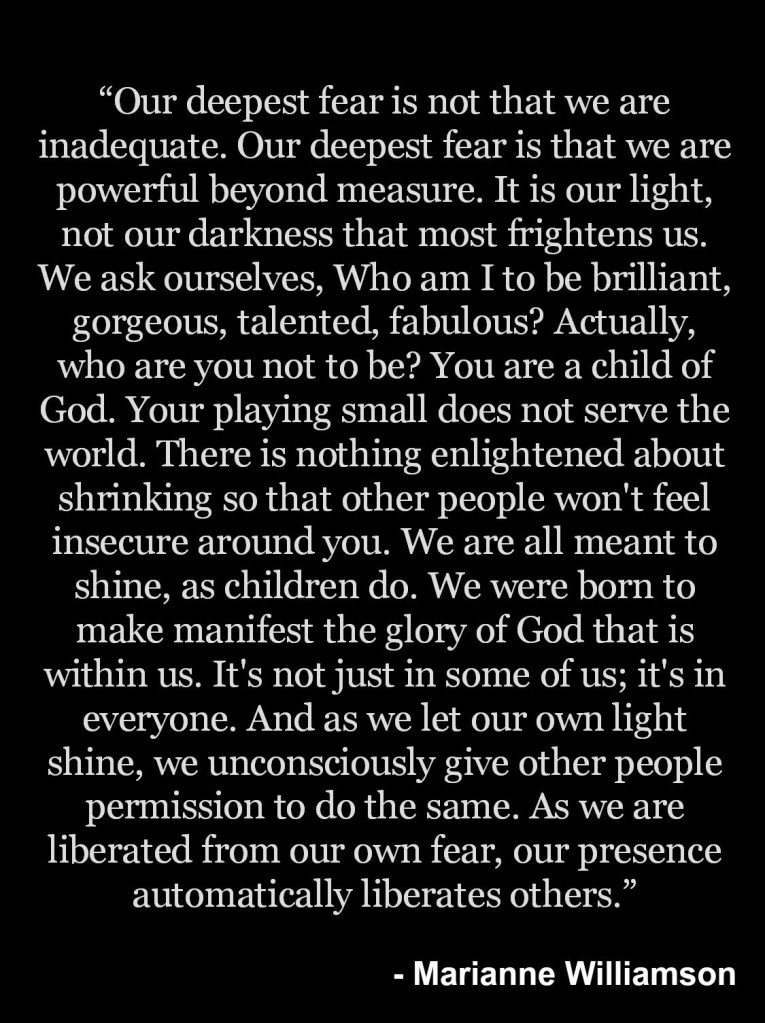
At the Richard Lawson Studios, we teach the concept of “arrogance”. The particular definitions we focus on are “claiming for oneself” and “pride”. Pride in what I am creating and accomplishing. And if those definitions don’t inspire you to let your light shine, then I’d like to share a quote by Marianne Williamson that Kelly recently reminded me of:

The Final Chapter: 7 Story Ideas in 7 Days.

Last Sunday, I updated everyone on how it went with the challenge I gave myself to generate 7 story ideas in 7 days: https://chasingthegeorge.com/2023/03/26/7-story-ideas-in-7-days-part-2/

I ended up generating 12 story ideas! I also mentioned last Sunday that I would complete the second part of the story generator exercise in chapter one of “My Story Can Beat Up Your Story”, by Jeffrey Alan Schechter: Try to give your story ideas a strong wish fulfillment, emotional dimension, market-savviness, and originality. Any that don’t hit all four points, take out behind the barn and Old Yeller ’em. Of the ideas that survive, put the best one aside for later.

Here are some of my observations. 1) Of the 12 story ideas I generated, two were a YES because they fulfilled the four categories above the strongest. Four story ideas were MAYBES, and six were a NO. These maybes and nos were weak in at least one of those four categories. Keep reading below.

2) With the exception of three story ideas, I was able to find similar movies within the same zip code for the other nine story ideas. And at some point, I’ll watch the trailers of all the movies I wrote down during my research. Fun fact: For one of the story ideas I generated, there were a ton of movies already made about it. Who knew that feature films about bakers were so popular? LOL. Keep reading below.

3) From doing these chapter one exercises, it helped me to revisit an idea I’ve been wanting to develop further for a while. I was able to carve out this idea a little more, and it won’t leave me alone. I ran it through the four categories and it came out as a yes as well. Keep reading below.

4) I was pleased that I was able to set up the orphan status for each protagonist I created over the 12 story ideas. Some were more orphaned than others, but they were all orphans. What do I mean by an “orphan”? According to “My Story Can Beat Up Your Story”, every protagonist travels through four character archetypes within a feature film (orphan, wanderer, warrior, and martyr.) Each archetype represents a specific moment of the protagonist’s journey, and they help them fulfill a complete arc of change from beginning to end. Every protagonist starts as an orphan of some kind. They stand out or are different in some way because of their choosing or because society sees them as that. Some unfortunate or challenging circumstance has already fallen upon them when the movie starts or will fall upon them. We immediately empathize and root for the protagonist because we see their orphan status in the first act. Keep reading below.

5) Even though I came up with 12 story ideas, there were only a couple that I would consider developing further. Again, I’m not being critical of or judging what I generated. What I mean is that I want to be passionate about the things I write. I don’t want to devote my time to writing a script I’m not passionate about. Being passionate about what I want to write was a big takeaway from this exercise (and a reminder.) Now, I think it’s time to throw my hat into the ring and take this nine-week feature film course through the Sundance Collab. I just have to choose which idea to take with me!

7 Story Ideas In 7 Days. Part 2.

Hello my fellow artists! Last Sunday, I challenged myself to generate 7 story ideas in 7 days by utilizing the story generator exercise in chapter one of “My Story Can Beat Up Your Story” by Jeffrey Alan Schechter. Here is the link to that blog entry: 7 Story Ideas in 7 Days. Part 1.

And as promised, here is part two where I update you all on how it went! Below, I have italicized Jeffrey’s prompts for context. I also copied and pasted the story generator website at the end so that you can try it at home!

Pick a description from Column A such as “ugly,” “creative,” “brave,” etc. Turn that word into the ultimate expression of that description: “ugliest,” “most creative,” “bravest.” Pick a profession from Box B such as “astronaut,” “soccer coach,” “school teacher,” etc. The first few times I did this, I wanted to be intentional with the pairings. Meaning, I went through the descriptions in column A until one resonated with me. Once that happened, I went through the list of professions in column B until one resonated with me as well. Then, I paired those words together to arrive at a newly-invented character. For example, Bravest Disc Jockey. Keep reading below.

Set the timer on your phone for five minutes. Without stopping to think, crank out a story idea for the “somethingest character” you just randomly invented. The “ugliest blacksmith” or the “most fearful pilot.” Once I invented a character, I was on go. I followed whatever impulses came to me. I did not question or critique the spontaneous story idea I was generating in real time. Once my five minutes was up, I let it go. I didn’t dwell. I moved on to generate the next character combination and story idea. There were a few moments where I stopped in the middle of a story idea, and it was in those crucial moments that I made sure not to get in my head or become critical. I just told myself to be patient and see what else occurs. There were a couple of times where I chuckled (in a good way) to myself because the story I was generating was so fun, wild, and imaginative. I was like, “Wow, look at what I’m writing down. This is pretty funny and cool!” Keep reading below.

The next few times I did this exercise, I decided to just pick a description from column A and a profession from column B without thinking about it. Just quickly pick one thing from each column and generate a story idea. I wanted to see what would happen if I went with this approach versus the one above where I was more intentional with the pairings. I was pleasantly surprised with this approach because I still found myself generating a story idea for each character I created. Keep reading below.

I ended up generating 12 story ideas! I’m proud of myself because I came up with something each time around, no matter the type of story, the genre, the boldness of it, the simplicity of it, etc. Now that I have done this part, I need to tackle the next steps of the chapter one exercise: Try to give your story ideas a strong wish fulfillment, emotional dimension, market-savviness, and originality. Any that don’t hit all four points, take out behind the barn and Old Yeller ’em. Of the ideas that survive, put the best one aside for later. Keep reading below.

Let’s see how this goes! Hmmm, I feel a part three coming up. Here is the link to Jeffrey Schechter’s story generator exercise: http://mystorycanbeatupyourstory.com/mix-match/

7 Story Ideas in 7 Days. Part 1.

Hello, my fellow artists! I recently looked at my DOIN (Declaration of Independence aka business plan) to see what to tackle next on the writing side of my career. And currently, I’ve been submitting a feature film script and a half-hour pilot script to well-established, legitimate writing competitions. So now, it’s time to go on a new literary journey! And one of the career checklist items within my DOIN says to “Generate story ideas using the exercise provided at the end of chapter one of ‘My Story Can Beat Up Your Story.'” This book, by Jeffrey Alan Schechter, is designed to help writers understand how to craft a strong and compelling story structure for feature film scripts.

I read chapter one again, and I’ve decided to generate one story idea each day for the next seven days. I’m not going to judge my impulses and instincts. I won’t critique them. I will be “on go” and allow myself to generate and write these ideas down. And then, next Sunday, I will provide an update on how it went. I will also reveal what part two will be (yes, there will be a part two!) I want to generate several ideas because I am eyeing a couple of writing courses I’d like to take through Sundance Collab (this is another item on my career checklist I want to tackle.) I want to take one of these ideas and develop them into a feature film script in one of these writing courses. Keep reading below.

Until next week! Oh yeah, on the theatrical acting side, I am still researching movies and TV shows for potential scenes to perform in scene study class. Next up, I am going to watch “Raising Arizona”, “A Fish Called Wanda”, “Dead Poets Society”, and I will continue watching season one of “Yellowstone” to keep exploring the role of Jamie. On the commercial acting side, I set a three-month goal at the beginning of the year to secure commercial representation. I diligently crossed things off my career checklist in that pursuit. And recently, my agency decided to expand their commercial footprint. I jumped on the opportunity and am now represented theatrically and commercially under one roof. Securing commercial representation has now been accomplished and checked off my DOIN. The next step is to take classes with commercial casting directors.

Spending My Summer With Ryan Murphy, et al!

Hello artists! As we quickly approach the beginning of summer, I decided to pull out an exciting blog entry from the vault and share it with all of you again. Below, I shared how I was preparing to spend my summer with the likes of Ryan Murphy, Phoebe Waller-Bridge, Steven Canals, Tanya Saracho, etc. to discover the shows and movies I would have killed to write on. And as I sit here today, I celebrate how far I’ve come since the original blog posting. It’s happening, folks, it’s happening! And I hope that my journey below helps you in formulating the kind of shows and movies you want to write, plus the literary reps and production companies to target.

Original post below:

On June 15th, 2019, I met with a mentor of mine for coffee in the Hollywood Hills. As countless luxury vehicles pulled in and out of the parking lot, I told him that I needed some help and direction in the TV literary world. A fellow Vassar graduate, I’ve known him for several years now. The writers retreat he hosted at the Sturtevant Camp in Sierra Madre, CA, is still one of my fondest memories.

I told him that I needed to navigate the TV literary world with more focus and clarity because I was a little bit all over the place. I also asked him how to obtain a literary manager. We spoke for a while and he gave me a lot of homework that would help me get more focused in this area, more focused on which literary managers would be best for my writing voice, and to discover opportunities for myself as a minority writer.

After taking pages of notes, I was excited to tackle the homework he gave me. One of the homework assignments was to identify 25 TV shows/movies that I would have killed to work on as a writer. He told me to create a spreadsheet and to include different columns of information for this particular homework assignment (e.g. the production company behind each show, the literary reps behind all the writers, etc.)

Side note: At the time of our meeting, I could only identify two TV shows that I would have killed to work on as a writer LOL.

After our meeting, I immediately got to work. I started watching lots of TV shows and movies to find my voice in them. Does this TV show or movie sound like my voice? Does this TV show or movie sound like what I’m interested in writing? I would watch at least two episodes of each TV show to see if I would add it to the list or not. I typed in specific genres that I was interested in. I looked at recommendations from Netflix, Hulu, and IMDB (i.e. “If you liked Black Mirror, then check out…”) Next thing I knew, my list of shows started to grow.

When my list grew to 15 shows, I hit a wall. I was like, “There is no way I’m going to find 25 TV shows/movies.” I emailed my mentor and asked, “Is 25 a hard number? Or can I have less than that?” I asked him this question knowing fully well what his answer would be. I knew that 25 was a hard number. And that he gave me 25 TV shows/movies to push myself, to explore, and to think outside of the box. He emailed me back and he confirmed everything I already knew. So, I recommitted to reaching the magic number of 25. And I’m glad I did because I didn’t want to take any shortcuts. I wanted to fully comply.

On July 27th, I reached the magic number! When I found my 25th show, I cheered! I was so happy and ecstatic. It took me almost a month and a half, but I got to spend my summer with Ryan Murphy, Ava DuVernay, Steven Canals, Tanya Saracho, Phoebe Waller-Bridge, Ryan O’Connell, and so many other amazing creators! And, I was also able to identify the literary reps behind them and behind all of their staff writers. These literary reps represented writers who represented my voice. Plus, I identified production companies that produce the kind of work I want to create as a writer.

I discovered/reconfirmed a few things with this assignment:

*I am interested in the following areas for TV: urban dramedies; stand alone sci-fi episodes; comedies where the lead character is truly an outcast.

*My writing heart resonates with half-hour TV shows.

*When it came to identifying movies, urban dramas made the list. Although, I also love comedic apocalyptic films like Shaun of the Dead and The World’s End (both written by Edgar Wright and Simon Pegg)

*ANYTHING IS POSSIBLE! When I saw the amount of creativity in each show, the storylines, the kind of different and dynamic leading characters, etc., I realized that ANYTHING IS POSSIBLE! There is an audience out there for any show and storyline. There is no way that my own TV series can’t be picked up. All of the shows I watched (whether they made the list or not) reconfirmed that my series has a place on TV. No one can ever tell me that there isn’t an audience for my work after all of the TV shows and movies I’ve seen.

So, ladies and gentleman, here are the 25 TV shows and movies that I would have killed to work on as a writer because they resonate with my writing voice. In no particular order:

  1. Pose
  2. Black Mirror
  3. Pen15
  4. Room 104
  5. Electric Dreams
  6. Weird City
  7. The Twilight Zone (the reboot)
  8. Special
  9. Bonding
  10. Shrill
  11. Difficult People
  12. Schitt’s Creek
  13. Ramy
  14. Barry
  15. Atlanta
  16. Fleabag
  17. Vida
  18. When They See Us
  19. Tales of the City (the reboot)
  20. Looking
  21. Moonlight
  22. Gun Hill Road
  23. Quinceanera
  24. Roxanne, Roxanne
  25. Culture Shock (part of the Into The Dark series on Hulu)

Header picture by Anete Lusina: https://www.pexels.com/photo/crop-person-standing-near-fence-and-old-tv-5721863/

Writing Competitions: Where To Start????

Hello my fellow artists! If you’re in the United States, I hope you are having a fun and safe Memorial Day weekend. For my fellow screenwriters and TV writers out there who are interested in submitting content to writing competitions, but don’t know where to start, I hope that my quick blog entry will help.

As with film festivals, there are a PLETHORA of writing competitions. It can seem and feel daunting when looking at the myriad of choices out there. For example, when I recently logged into my Coverfly account, the dashboard revealed 154 writing competitions available for submissions. 154?! What?!

And if you don’t know what Coverly is, here is some info about this platform: https://www.coverfly.com/brief-introduction-coverfly-writers/#:~:text=Coverfly%20is%20an%20opportunity%20for,your%20competition%20successes%20to%20work.

Submitting to writing competitions (and film festivals) as a way to get your work out there, to get noticed, to receive feedback or coverage, can become a very expensive endeavor. Don’t just submit blindly. The best advice I can give to you before you begin your journey is to do your homework. Research. When I started submitting my films to film festivals, yes, I submitted to some of the big ones (Sundance, Cannes, Tribeca, New York Film Festival, Atlanta Film Festival, etc.) cause why not? However, once I got the big festivals out of the way, I also did further research to find the festivals that would be tailor-made for my films. For example, if my film featured a Latinx cast and storyline, then I knew that I should find film festivals that were geared towards Latinx-based projects. If my film was directed by a woman, then I found film festivals that celebrated and encouraged films directed by women. If my film was sci-fi, then I found film festivals that focused on this particular genre.

As a result, my submissions became more targeted. More focused. My films fell within the zip code of those particular film festivals because I was speaking their language. Writing competitions are no different. Do the research. Aim for the big ones (cause why not?) and aim for the ones that are targeted to the type of script you have for a more specific, bullseye approach. Not all competitions are equal and built the same way. Some have been around for a while and are highly-regarded and respected. Others are brand new and have only been in the game for one year. Some competitions come and go.

Some factors to consider: how long the competition has been in existence for, its mission statement, its end goals for the writers who enter and win, the judges involved in the competition, the sponsors behind the competition, etc. By the way, I’m not here to say which ones to submit to and which ones to avoid. It’s up to you to do the research and decide for yourself. Listen to your instincts and use your common sense.

Below, I have listed a few established, industry-recognized writing competitions. I found these writing competitions based upon industry colleague recommendations and through my own research. There may be a lot more established, industry-recognized writing competitions, but at least this list will get your wheels going (If you know of other established writing competitions, please leave a comment below so I can add them to the list.) And with the exception of the Academy Nicholl Fellowships which only focuses on screenplays, the other competitions listed below accept both screenplays and TV scripts.

Academy Nicholl Fellowships: https://www.oscars.org/nicholl

Austin Film Festival: https://austinfilmfestival.com/submit/screenplay-and-teleplay-submissions-2/

Final Draft Big Break: https://www.finaldraft.com/big-break-screenwriting-contest/

Page Awards: https://pageawards.com/

ScreenCraft: https://screencraft.org/screenwriting-contests/

Scriptapalooza: https://scriptapalooza.com/

Script Pipeline: https://scriptpipeline.com

Shore Scripts: https://www.shorescripts.com

The Black List: https://blcklst.com/

Tracking Board Launch Pad: https://tblaunchpad.com/

Featured image courtesy of Suzy Hazelwood: https://www.pexels.com/photo/black-and-red-typewriter-1995842/