Hello, my fellow artists! Welcome to another exciting edition of my weekly blog. As you all know, I have two goals that I am focusing on this year. And each week, I am alternating between the two goals to provide updates that are hopefully inspiring and engaging. This week, we are back to my writing goal for 2024: Finish the 1st draft of the “Third Act” feature film script with Kelly Tighe. Once that’s done, do a table read, get feedback, and complete additional drafts.
Since our table read on July 14th, we’ve received wonderful feedback from fellow artists and industry professionals. The feedback has been universal and consistent, so it lets us know we are on the right track with what we have. We even had a writer-director-producer come into class this past Wednesday to clarify and expand upon his awesome notes. From all the feedback we’ve received, I believe the one that was the most thrilling and heartwarming was from Jeffrey Alan Schechter. Not only is he a two-time Emmy-nominated writer, but he is also the writer of the story structure book that we use extensively at the Richard Lawson Studios, “My Story Can Beat Up Your Story”. His book helped us shape and write “The Third Act”. His book helped me write two feature film screenplays, and I’ve used his book as a supplement during my Sundance writing course. Keep reading below 🙂
Jeffrey read our outline in 2022 and then came into class to provide us with constructive feedback. So, it was important to continue to involve him in the journey. Jeffrey read our script and had many beautiful things to say about it! In addition, he believes that our script is viable, a good and worthy story with characters so compelling as to attract talented actors. To receive this feedback from the same person whose template we follow is the icing on the cake. Special. Magical. Keep reading below 🙂
Our next step as a collective is to read all the feedback again and decide what to keep and discard. From there, Kelly and I will tackle the second draft of the script. Keep reading below 🙂
Hello, my fellow artists! Welcome to another exciting edition of my weekly blog. As you all know, I have two goals that I am focusing on this year. And each week, I am alternating between the two goals to provide updates that are hopefully inspiring and engaging. This week, we are back to my writing goal for 2024: Finish the 1st draft of the “Third Act” feature film script with Kelly Tighe. Once that’s done, do a table read, get feedback, and complete additional drafts.
On July 14th, 2024, the Professional Development Program 3.0 collective had a table read for the first draft of our feature film script! This journey started almost five years ago and it was based on a true story that Richard Lawson shared with us. From that true story, the collective worked together to research, brainstorm, and map out a story. In mid-2022, the collective appointed Kelly and I to make sense of all the research that was done up till that point and to write the script. On May 9th, 2024, Kelly and I finished the first draft of the script. Keep reading below 🙂
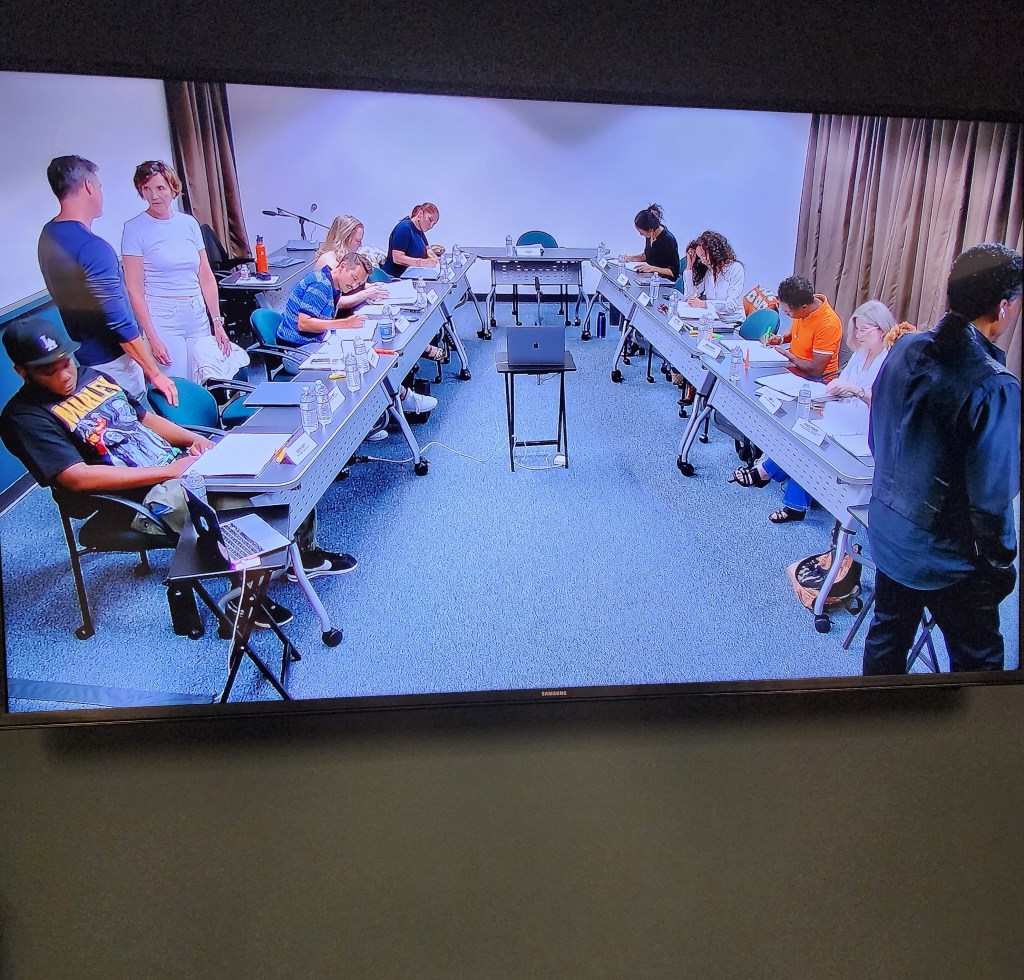
The entire experience was electric from beginning to end. Thank you, Craig Taggart, for lending us your beautiful office space for our art to occur and flourish. We set up the large conference room with tables and chairs. Craig printed out and placed name cards in front of each chair. Thank you Nic Monteilh and Mark Larwood for setting up the cameras and mics. As the actors arrived, there was a sense of excitement and community in the air. Thank you actors for the wonderful performances you gave. It was thrilling to hear these words come out of your mouths. It was also great to hear which moments/scenes worked and which moments/scenes didn’t quite land. Invited guests ranged from Richard Lawson Studios students to outside industry guests, and they either sat in the conference room with us or in another room where they could observe us through a one-way mirror. Thank you all for coming! Keep reading below 🙂
After the table reading ended, we handed out questionnaires for everyone to fill out. Once those were collected, we celebrated afterwards in the lobby area with food and wine. There was a buzz in the air. Actors and guests flowed positive comments and constructive feedback during the reception. After everyone left, Richard and the collective stood behind to debrief and to cement this huge win. This was a huge and successful win for all of us. It felt like we all gave birth, and the feeling was satisfying. This past Wednesday, we read through the questionnaires and discovered common themes, feedback, and suggestions that will be helpful when Kelly and I tackle a second draft. Also, Richard sent a copy of the script to Jeffrey Alan Schechter for feedback. Jeffrey wrote “My Story Can Beat Up Your Story”, and it is his book that we used to structure our outline and script. Fun fact: Jeffrey read our outline in 2022 and then came into class to provide us with wonderful feedback. Keep reading below 🙂
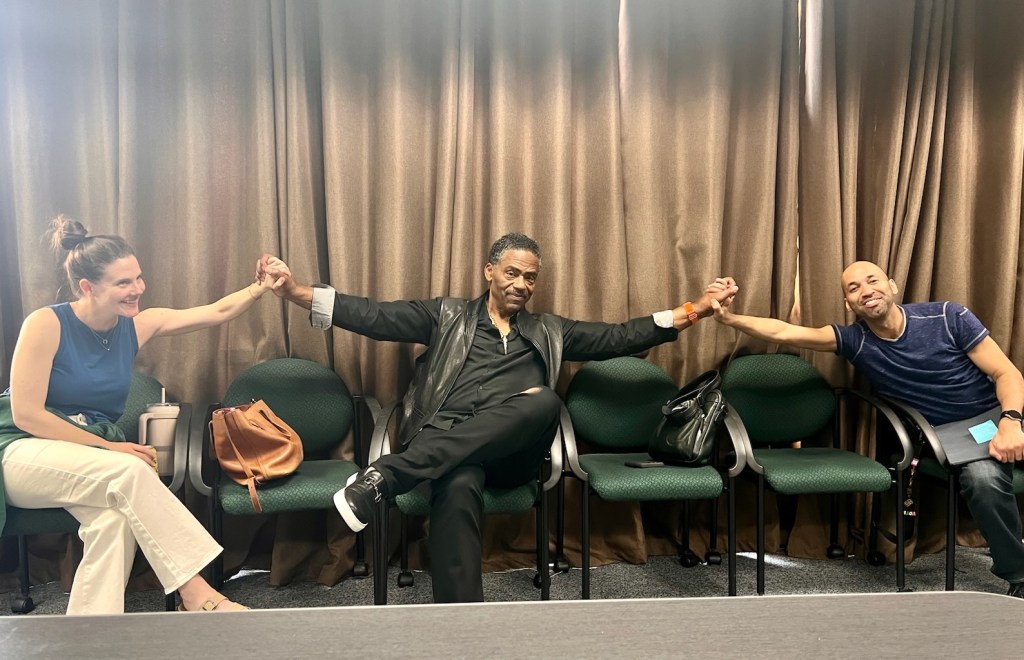
And finally, thank you to such an incredible collective: Richard Lawson, Beth Berlin, Lindsay Hopper, Sayaka Miyatani, Jorge Ortiz (yes, I’m including myself even though I’m writing this blog LOL), and Kelly Tighe. We are all excited for the next chapter of movement and development.
Hello, my fellow artists! Welcome to another exciting edition of my weekly blog. As you all know, I have two goals that I am focusing on this year. And each week, I am alternating between the two goals to provide updates that are hopefully inspiring and engaging. This week, we are back to my writing goal for 2024: Finish the 1st draft of the “Third Act” feature film script with Kelly Tighe. Once that’s done, do a table read, get feedback, and complete additional drafts.
The day has finally arrived! The PDP 3.0 collective will witness an exciting cast of actors perform our feature film script today. We have our location. We have our signed NDAs. The actors received their scripts via email this past Wednesday. We have invited guests to observe. We created questions to ask the actors and guests afterwards. Hardcopy scripts will be available at the table read. We will have food and drink. Richard came up with the exciting idea of filming the table read with three cameras so we could later edit it and send it out as a marketing tool to interested parties. Keep reading below 🙂
I can’t wait to let you all know how it went! See you all next week!
Hello, my fellow artists! Welcome to another exciting edition of my weekly blog. As you all know, I have two goals that I am focusing on this year. And each week, I am alternating between the two goals to provide updates that are hopefully inspiring and engaging. This week, we are back to my writing goal for 2024: Finish the 1st draft of the “Third Act” feature film script with Kelly Tighe. Once that’s done, do a table read, get feedback, and complete additional drafts.
Things are moving and cooking with this goal! This past Wednesday, June 12th, 2024, the Professional Development Program 3.0 collective met again via Zoom to start casting actors for our first, official table read of “The Third Act”! We have our date (July 14th!), time, and location. It was so exciting to go through each character and envision a few actor choices for each one. We entered our choices into a spreadsheet and certain members from the group will reach out to those actors to get their interest and availability. The intention for the table read is to hear the script in the hands (and mouths) of these actors, ask them questions, and receive feedback. This process will allow us to determine the next set of rewrites for the second draft of the script. In the meantime, Kelly and I will cut down the script before it is emailed out to the actors. Keep reading below 🙂
Hello, my fellow artists! Welcome to another exciting edition of my weekly blog. As you all know, I have two goals that I am focusing on this year. And each week, I am alternating between the two goals to provide updates that are hopefully inspiring and engaging. This week, we are back to my writing goal for 2024: Finish the 1st draft of the “Third Act” feature film script with Kelly Tighe. Once that’s done, do a table read, get feedback, and complete additional drafts.
This goal is moving along! As you all know, Kelly Tighe and I finished the first draft of the script on May 9th, 2024. This past Wednesday, May 29th, we had our first reading of the script with our Professional Development Program 3.0 group! It was a beautiful, exciting, full-circle moment because the story originated and developed in this class. Then, the journey progressed when the group assigned Kelly and me to write the first draft of the script. She and I could feel and see the excitement in the room. Keep reading below 🙂
It was wonderful to be back on Zoom with the group. The last time we saw each other was mid-2022! Everyone was excited to hear the script and celebrate this monumental moment together. I decided the best way to present the first draft was to have each person read a scene(s) out loud. I kicked it off, then Kelly read the next scene, then Lindsay, then Beth, and then Sayaka. Richard didn’t read but was actively listening and engaged. It was thrilling to hear other people read these words out loud. As we read through the script, Kelly and I made real-time edits to the Final Draft document. She and I also wrote notes to discuss and tackle in the next rewrite. She and I were also making edits in our minds during the reading. We saw which scenes we could trim down and how. Keep reading below 🙂
Another aspect of the reading was seeing how the story and characters landed on the group. Until then, Kelly and I were the only ones reading these scenes out loud for the longest time. People laughed and gasped. People had visceral reactions at certain moments in the script. A couple of people got emotional reading certain scenes. Everyone cheered when the script ended. Richard was so proud of Kelly and I. He praised the script, the story, the characters, the structure, and the tension that we maintained throughout the story. Richard congratulated Kelly and me as a writing duo, stating that this script is a calling card for us as writers. He believes that this is a viable script that can be produced. Everyone is excited to move forward with this script. Keep reading below 🙂
Kelly and I felt such an incredible sense of accomplishment and pride afterwards, a joy and understanding that keeps settling in that we wrote a feature film together. We enjoyed every moment of writing together. A new writing duo is born? Keep reading below 🙂
Hello, my fellow artists! Welcome to another exciting edition of my weekly blog. As you all know, I have two goals that I am focusing on this year. And each week, I am alternating between the two goals to provide updates that are hopefully inspiring and engaging. This week, we are back to my writing goal for 2024: Finish the 1st draft of the “Third Act” feature film script with Kelly Tighe. Once that’s done, do a table read, get feedback, and complete additional drafts.
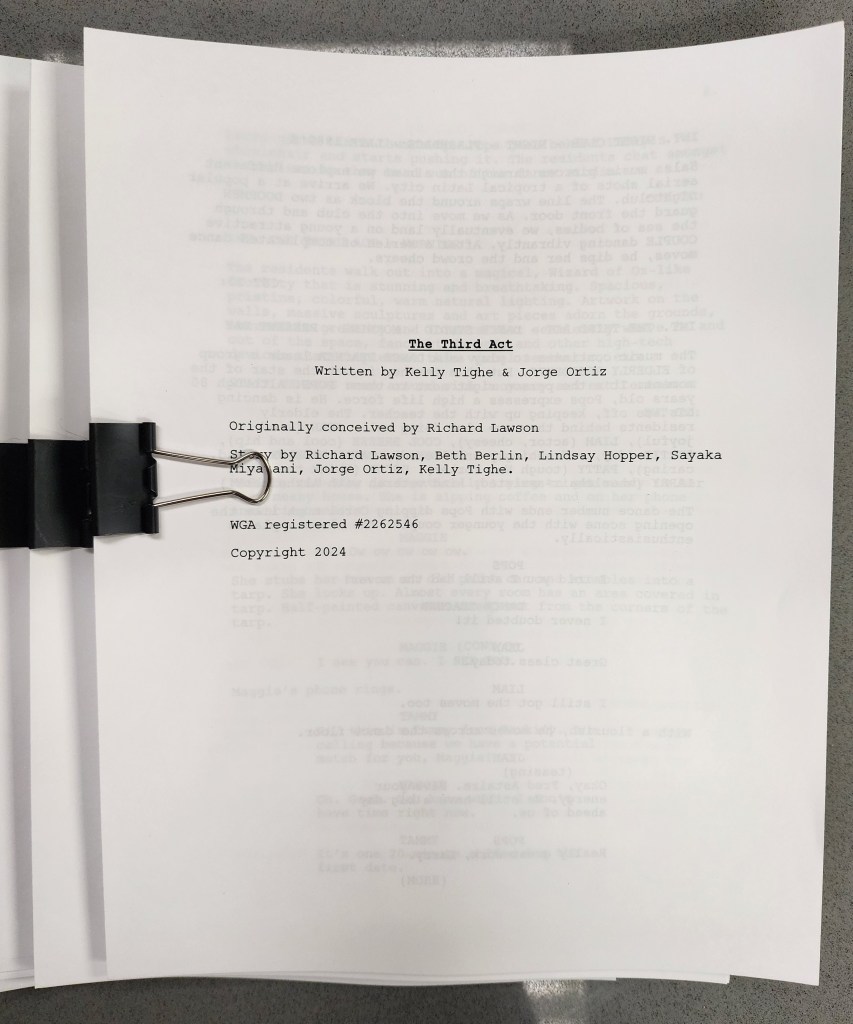
On May 9th, 2024, at 12:51pm, Kelly Tighe and I finished the first draft of our feature film script!!!!!!!!!! THE SCRIPT IS COMPLETED! 166 pages! As soon as we finished reading the last scenes we wrote, we asked each other, “Are we done? Did we finish the script?” And once we answered “yes”, we cheered, cried, danced, threw our hands in the air, and looked at each other with pride, joy, and a deep sense of accomplishment. A feature film script! This journey started in September 2019 when Richard pitched a story idea to the PDP 3.0 class. In the middle of 2022, the journey evolved when the group appointed Kelly and me to take over, make sense of everything, find the story to tell, and write a first draft. We devoted the rest of 2022 to making sense of the notes and research, various story ideas, characters, scenes already written by the PDP 3.0 company, etc. We revised the logline to reveal the story we ultimately decided to tell. We revised the central question to support the logline. We revised and cleaned up the entire outline. We removed a few characters and older scenes while keeping and strengthening a few other scenes. In January 2023, we took the bold step to start writing the script. A year and a half later, here we are! Keep reading below 🙂
Kelly texted the group to let them know about the great news. In the meantime, Kelly and I will meet this week to clean up any spelling and grammatical errors, check for any tracking/logic issues, etc. Then, we will meet with the PDP 3.0 group on May 22nd to catch up, celebrate, and plan the next steps, such as registering the script with the WGA, copyrighting the script, and having the group read the script together to generate questions and feedback before we do a table read. Thank you, Richard and PDP 3.0, for entrusting Kelly and me to write this script. We look forward to continuing this journey with you all to the next level of development and, ultimately, the bigger picture of production and distribution. Keep reading below 🙂
I’ll end with this. This past Thursday night, Richard invited acclaimed casting director John Frank Levey to speak to our scene study class. At one point, Richard and John talked about the importance of celebrating our wins (by the way, John loves that we share our wins at the top of the class.) John said, “We have to look for our wins, and we have to celebrate them cause that will give us confidence…” Richard added, “I kind of look at wins like gassing up. Where you put a little gas in your tank because ‘I had this wonderful experience’ or ‘I finished writing this script after five years’…it puts fuel in your tank to keep going.” John then shared a story about a recent talk he had with students from Carnegie Mellon University, and he connected it to our script. He said, “I was trying to encourage them to get the long view (about having a career). Don’t think of it like, ‘I gotta get this done by Wednesday.’ If it took five years to finish your script, you finished it. God bless you!” He and Richard then talked about projects that took a while to get off the ground. The lesson was that it’s about a sustained effort with intention. Keep showing up. The sustained effort now continues into the next chapter of this feature film script journey. Keep reading below 🙂
Hello, my fellow artists! Welcome to another exciting edition of my weekly blog. As you all know, I have two goals that I am focusing on this year. And each week, I am alternating between the two goals to provide updates that are hopefully inspiring and engaging. This week, we are back to my writing goal for 2024: Finish the 1st draft of the “Third Act” feature film script with Kelly Tighe. Once that’s done, do a table read, get feedback, and complete additional drafts.
Act 3 is coming along, and Kelly and I had a great writing session this past Wednesday. After our writing session, Kelly decided to tackle the second to last scene in Act 3, and I realized that I needed to write a “transition” scene between two other scenes I wrote in Act 3. There was a harsh, quick timeline/story transition between those two scenes. I knew we needed a scene in between that would allow the characters and the audience to breathe for a second and to fill in the blanks a little bit more in terms of making sure the logical and emotional progression of the story continued so that when the next scene occurs, the audience doesn’t say, “Wait. Woah. What just happened? This next scene came out of nowhere. It felt jarring.” I am excited to share the scene with Kelly this week and hear her thoughts. Keep reading below 🙂
In other writing news, I had the pleasure of providing advice to a high school student this past Tuesday who wrote a short film script that they eventually want to develop into a feature film. A colleague and friend initially reached out to see if I would be available and willing to provide assistance and feedback on this student’s short film script. I said yes, and they connected me with the student’s teacher. I coordinated with the student’s teacher to set up a Zoom meeting so we could meet. I read the student’s script a few times before our meeting, generated notes and questions, and looked forward to meeting the two of them. The meeting went GREAT! The student had a positive attitude from start to finish. They received my notes and asked me questions. The teacher was so appreciative and thanked me for meeting with the two of them over Zoom. The next day, the teacher emailed me and said that the meeting was impactful and her student was eager to share their experience with their classmates. Keep reading below 🙂
Two days later, I receive a text message from another colleague and friend asking if I would like to read a feature film script they wrote for a specific TV network. I said yes, and look forward to reading it as well. Hmmm, I may have to look into writing consulting 🙂 🙂 🙂 It’s been a productive past week of writing that also included writing letters to people on my relationship map and paying attention to the writing structure in a feature film I watched. Keep reading below 🙂
Hello, my fellow artists! Welcome to another exciting edition of my weekly blog. As you all know, I have two goals that I am focusing on this year. And each week, I am alternating between the two goals to provide updates that are hopefully inspiring and engaging. This week, we are back to my writing goal for 2024: Finish the 1st draft of the “Third Act” feature film script with Kelly Tighe. Once that’s done, do a table read, get feedback, and complete additional drafts.
Writing is a process. Each writer will share a different story about how long it took them to write a particular script, why it took that length of time, and the resources and research they utilized to make it happen. I thought it would be cool to crunch some numbers behind our feature film script so that people have a reality of what it’s taken to bring this script to life. And like I mentioned in my February 18th blog entry, this script started as a group project until Kelly Tighe and I were appointed/anointed to take over the reins in the middle of 2022. I want to thank our PDP 3.0 group for the numbers they contributed to this endeavor as well! So let’s go:
7 main folders in the Google Drive: Characters and Relationships, Feature Film Treatments, Miscellaneous Written Scenes, My Story Can Beat Up Your Story, Producing: Pitching, Agreements, etc., Research and Notes, Designs We Liked. Keep reading below 🙂
These 7 folders contained the following number of files within them: Characters and Relationships (15), Feature Film Treatments (9), Miscellaneous Written Scenes (21), My Story Can Beat Up Your Story (42), Producing: Pitching, Agreements, etc. (6), Research and Notes (191!), Designs We Liked (144!). Many of these files were Google Documents and PDFs that ranged from 1 page to 26 pages in length. Keep reading below 🙂
Since the inception of this journey, here are the number of weeks and hours put towards this script-give or take some numbers here and there because of pillar jobs, life circumstances, job bookings, a world-wide pandemic, economic uncertainty, much-needed and well-deserved breaks and vacations, writer blocks, writer and actor strikes, etc.: 4 years, 6 months (and counting), 450 hours (and counting) during our designated writing sessions, untold hours outside of our designated writing sessions, and 132 pages (and counting) of our first draft. Keep reading below 🙂
And just for fun, levity, and humor:Untold numbers of coffee drinks, dance breaks, bathroom breaks, lunch breaks, tears of joy, tears of frustration, Google searches, YouTube searches, character name changes, rewrites, rewrites, and more rewrites. Keep reading below 🙂
I’m back! I took a few days off to engross myself in a series of much-needed celebrations. The celebrations kicked off with a weekend trip to Las Vegas on March 1st (my partner and I enjoyed attending the National Rugby League games at the Allegiant Stadium, Chippendales, lunch at Hell’s Kitchen, drag brunch at Señor Frogs, a bottomless mimosas brunch at Delano, people watching, etc.) The celebrations ended in LA with us attending Madonna’s Celebration Tour!!!! She’s currently on her first-ever greatest hits tour (celebrating four decades of an incredible, amazing, and enviable musical catalogue.)
Okay, so let’s get back into it. As you all know, I am working on two goals for this year. One goal is to book supporting roles in feature filmsproduced and distributedby independent or mid-sized studios. The second goal is to finish the first draft of a feature film script that Kelly Tighe and I are writing through our Professional Development Program 3.0 collective. This week, I want to update you all on the progress made with our feature film script. Keep reading below 🙂
Kelly and I are currently working on the end of act two (we’ve written 129 pages so far!) She is rocking it out with the scenes she is currently working on. I was too…until I hit a wall with a particular scene for plot point Yes 14 (In “My Story Can Beat Up Your Story”, the Yes/No are known as “reversals” because these particular plot points “alternate between answering the central question first yes and then no. Anything that brings the hero closer to his or her goal is a ‘yes’. Anything that takes the hero further away is a ‘no'”. There are a total of 28 Yes/No reversals in act two. There is also something known as “the third-act solution”, which is introduced during Yes 7. “The third-act solution is a device, a situation, or a skill that is shown to the audience early, but is what the main character will need to be victorious in the end. Not every film has one, but it’s cool when films do.” The third-act solution is used during the Final Yes in act three. Keep reading below 🙂
I say all of this because I had the pleasure of writing the scene that introduces the third-act solution in Yes 7. I also had the pleasure of tackling Yes 14 and using this plot point to start setting up how exactly the third-act solution will pay off during that Final Yes in act three. LOL I could not figure this scene out. And when I thought I had it figured out, I quickly realized it wasn’t going to work for a variety of reasons. So literally, I was going through my own personal Yes/No reversals LOL. Yes, I figured it out. No, I didn’t figure it out LOL. Keep reading below 🙂
When I met with Kelly on February 21st for our writing session, I told her I was stuck with this scene for the last three weeks. She gave me some ideas that totally made sense to help me set up the third-act solution! Thank God for a sounding board. Sometimes, the work is so close to your face that you can’t see the answers or the picture in front of you. It takes that sounding board, that partner, to grab your hand and move the work further away from you. “Oh, now I see it!” Armed with these ideas, I sat down in front of my laptop, opened up Final Draft, and got to work. Well, I got stuck again LOL. I had these great ideas, but how do I now connect them in a cohesive way? And without giving away the story, certain characters partake in a drink during this scene that sets up the third-act solution. Okay, cool. But how do I utilize this drink to help the characters arrive at and experience these ideas in an uncontrived way? How does the drink drive the scene so that these ideas can be executed? And then, I had an “a-ha” moment. A light bulb went off in my head. OF COURSE! Keep reading below 🙂
I could utilize the drunk physical state exercise that I have seen several times at the Richard Lawson Studios to connect these ideas in the scene. This exercise is part of a number of cold acting exercises that Richard uses to let actors know that they are enough. That they can create art on the spot with little to no preparation because they have everything in their possession and beingness to do so. All of the cold exercises (some of which Richard created and originated) have an improvisational quality to them and they challenge the actor to be present, moment to moment, and interested. In the drunk physical state exercise, a group of actors go on stage and pretend that they are at a bar or party. The stage manager will give the actors water bottles and they have to determine what kind of alcohol they are drinking. The teacher instructs the actors to take a shot from their water bottles. They do so and the scene begins. At some point, the teacher says, “Freeze! Take another shot.” The actors take another shot and the scene resumes. The teacher will say freeze a few more times and instruct the actors to take another shot. This cold exercise is always fascinating and fun to watch because the progression of the alcohol drives everything. The actors get into more belief, they loosen up, they let their imaginations run wild, a story develops, humorous and dramatic moments occur, and the stakes get higher and higher. Keep reading below 🙂
The scene I am writing is a drunk physical state exercise, and these characters are a part of it! With this concept in mind, the writing flowed quickly and easily. It all made sense, and I understood how to use the progression of drinking to determine the chronological order of these ideas, how these characters arrived at them, and the degree to which these characters experienced them. I was happy and excited when I wrote this scene. I could see the progression of this scene from one drink to the next. I couldn’t wait to share this scene with Kelly at our next writing session. When I shared this scene with her, she loved it. We exchanged a few thoughts and I am excited to apply them in my next rewrite for this scene. Keep reading below 🙂
Next week, I will update you all on the progress I made with my acting goal!
Hello, my fellow artists! It’s time for another exciting blog entry from yours truly. In today’s edition, I wanted to bring some love to my second goal of 2024: Finish the 1st draft of the “Third Act” feature film script with Kelly Tighe. Once that’s done, do a table read, get feedback, and complete additional drafts.Keep reading below 🙂
“Third Act” came to life back in September 2019 when the Professional Development Program 3.0 class decided to turn into a production company to workshop ideas and bring them to life. The idea for this script came from Richard Lawson, and it was based on an article he read many years ago about a scandalous incident that occurred in a nursing home. Over the next few years, the company met every Wednesday at 12pm to carve out this idea. We did tons of research, asked tons of questions, put forth tons of ideas, watched many films, put together look books, created character breakdowns, wrote scenes, scrapped scenes, wrote scenes again, etc. We even had Jeffrey Schechter, who wrote “My Story Can Beat Up Your Story”, read our outline and then come into class to provide us with feedback. Keep reading below 🙂
Throughout it all, the whole process was one of incredible respect, asking the next question, and “yes, and…” There was never a time where one of us shot down someone else’s ideas or writings or were critical over someone else’s work or research. And that’s a testament to the culture that Richard and the company created and instilled over the years. Our mindset was always on the bigger picture, the pursuit of excellence and collaboration, and the love of creating art. It’s why directors like Martin Scorsese and Quentin Tarantino work with the same people in front of and behind the camera all the time: Because they are NOT PAINS IN THE ASS. Keep reading below 🙂
At some point, with the plethora of notes and research gathered over the years, it was time to appoint a couple of individuals to make sense of it all and take the reins of writing a complete first draft. Kelly Tighe and I were appointed to be those individuals, and we started the process in the middle of 2022. She and I met every Wednesday to begin the bold, colossal step of distilling, editing, and striking pages worth of story ideas, notes, characters, scenes already written by the company, etc. We continued asking the next question, did more research, and combed through everything (and I mean, everything) one piece at a time with the patience of a saint LOL. We repeatedly edited the logline, the central questions, and the plot points. We kept referencing “My Story Can Beat Up Your Story”. Each action provided just a little more clarity. The entire process took a long time, and we still hadn’t written ANYTHING yet. Not one page! However, we knew that all this work was vital. We knew that we couldn’t tackle the writing until we knew what story we wanted to tell. Keep reading below 🙂
I’ll never forget the day when Kelly and I finished combing through the entire outline and things finally made sense! We cheered and cheered and cheered! This was a huge win and moment for us! The outline was clear, and as a result, we were empowered to start writing. And again, our meetings were always positive, encouraging, and “yes, and…” We asked each other questions. We never invalidated each other. We never thought an idea was too stupid or ridiculous. The plot points within the outline became our guide and compass. The writing began to flow from us. We would assign ourselves a plot point and write the scene(s) for it throughout the week. When we would reconvene on Wednesdays, it was so cool to witness how synchronistic our writing ended up. For example, how something she set up in her scene paid off in my scene and vice versa. Or how her scene transitioned seamlessly into my scene and vice versa. Keep reading below 🙂
There were moments where we hit walls and roadblocks too. Moments were life took over and we couldn’t meet. Moments where we didn’t have any clue on how to write a particular scene(s) for a plot point. But understanding that writing is a process, we gave ourselves grace and encouragement. We also continued to ask the next question. When we did these things, clarity occurred. And currently, we have six more plot points left to write scenes for, and then we will be done with our first draft! And to give context, there are a total of 44 plot points in our script (this is the number of plot points that “My Story Can Beat Up Your Story” says is required to fulfill a feature film script.) Kelly mentioned this past Wednesday, February 14th, that it has taken us a long time to get to this point, but then she quickly remembered a friend who mentioned that it took her friend six years to write their musical. And I thought about other writers who took years to finish their scripts too. So, we’re doing good! Keep reading below 🙂
Kelly and I can’t wait to finish this first draft so that we can present it to our PDP 3.0 company and take the next steps. We are also interested in presenting the script to the Thursday Scene Study class so that students can see an example of the sustained effort it takes to create something from scratch. See picture below 🙂






 Chasing The George