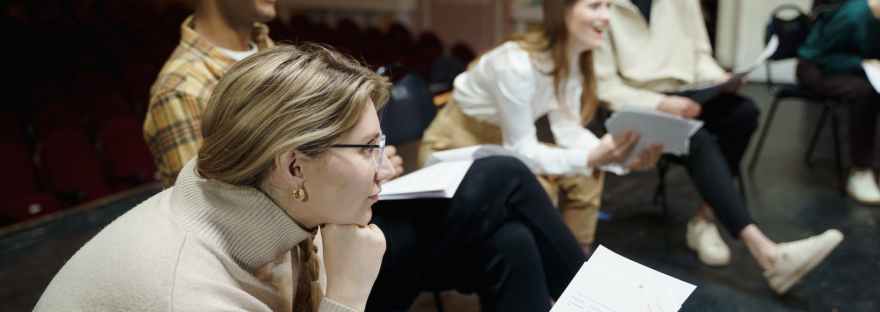
Let’s Rehearse! Part 4.

Hello, my fellow artists! I hope you’re all having a great week. For the past three weeks, I’ve been sharing my rehearsal process experiences for scenes I’m working on for my acting class. Keep reading below 🙂

In part 4, I wanted to share two videos from the rehearsal process. My scene partner (who lives in the U.K.) and I are working on a scene from “Beverly Hills Cop 2”, and we are in the second 40% of the rehearsal process. 40/40/20 is a technique created by Richard Lawson to help us effectively utilize the time we have to work on something. The first 40 percent of the time you have to work on something consists of research and gathering information. The second 40 percent of the time you have to work on something involves implementing and applying the research and information you gathered in the first 40 percent (aka getting it up on its feet.) The last 20 percent of the time you have to work on something is devoted to locking in your product and coasting towards the finish line. Keep reading below 🙂

In the first video, you will see one of the many improvisations we did to explore the history of our relationship. In this take, we decided to improvise Axel solving his first case, and the more celebratory nature of that event. This was the first time I allowed myself to relax and be a little more chill around Axel…so that was a good discovery. In the previous improvisations, I was more strict and tough with Axel. See video below 🙂

In the second video, we implemented some things like behavior and subtext frome one take to the next. The second 40 percent of implementation involves trial and error and experimentation. It’s failing forward. We are implementing the things we gathered from the first 40 percent to start bringing these characters and this scene to life. See video below 🙂

Let’s Rehearse! Part 3.

Hello, my fellow artists! I hope you’re all having a great week. For the past two weeks, I’ve been sharing my rehearsal process experiences for scenes I’m working on for my acting class. Keep reading below 🙂

In Part 3, I wanted to share my experiences of going through the second 40 percent of the rehearsal process. 40/40/20 is a technique created by Richard Lawson to help us effectively utilize the time we have to work on something. The first 40 percent of the time you have to work on something consists of research and gathering information. The second 40 percent of the time you have to work on something involves implementing and applying the research and information you gathered in the first 40 percent (aka getting it up on its feet.) The last 20 percent of the time you have to work on something is devoted to locking in your product and coasting towards the finish line. Keep reading below 🙂

It had been a while since I last rehearsed a scene in person, so this second 40 percent was like learning how to ride a bike again. Here are some highlights from “Yellowstone”. Rehearsing face to face, in person, was a wildly different experience. I had to deal with another person in the flesh, and the level of energy and impingement was higher. More visceral. There was no Zoom screen keeping us apart or keeping us safe. We did a rough walk through and I blanked out on my lines. “Oh yeah. I need to remember how to walk and talk again!” I found myself being uncomfortable with stillness and feeling like I needed to move. I found myself being uncomfortable with arbitrary movement and feeling like I needed to be still. I implemented different ways of sitting at the top of the scene to discover which position would put me into the belief and experience of my actual event and moment before (I haven’t nailed this sitting position yet.) Keep reading below 🙂

Back at my office, I watched one of our recorded Zoom rehearsals, and took notes of what I wanted to change from my performance. Funny, I record all my auditions to see if my work is translating on camera, but this was the first time I recorded rehearsals for scene work. Duh! Recording the rehearsals and watching them afterward was invaluable. I spotted a technical and performance thing that I wanted to change. In this second 40 percent, we also had a couple of rehearsals over Zoom where we identified one emotional throughline at a time and played it throughout the entire scene to see what we could discover. Keep reading below 🙂

For “Beverly Hills Cop 2”, we did a series of improvisations to carve out our relationship and to implement some ideas we wrote down from previous rehearsals. It was great to see how several of the questions we asked and the research we did together made their way into our improvisations. Through these improvisations, we saw how the history of our relationship evolved and progressed to the present-day scene we are doing. I also began implementing the beginning of my character’s wardrobe and his physical stance in the scene. We implemented our subtext in a few of our run throughs and also implemented ideas into certain sections of the scene. I also recorded these improvisations and watched them back to study my performances. Keep reading below 🙂

See you all next week where I will share an improvisation or two from “Beverly Hills Cop 2” and continue the journey through the second 40 percent.

Let’s Rehearse! Part 2.

Hello, my fellow artists! Last week, I mentioned being inspired by a series of rehearsal technique workshops at the Richard Lawson Studios and how I couldn’t wait to get into rehearsals for two scenes I’m working on for class. I also talked about utilizing the concept of 40/40/20 in my rehearsal process. 40/40/20 is a technique created by Richard to help us effectively utilize the time we have to work on something. Keep reading below 🙂

In Part 2, I continue going through the first 40 percent by sharing a few handwritten notes I took during my rehearsals! Think of it as a visual, inside look into my first 40 percent of the rehearsal process (notes aka the secret sauce I am using to create and make sense of what is going on before my scene partners and I get our scenes up on their feet.) As I mentioned last week, the first 40 percent of the time you have to work on something is devoted to research, gathering information, asking questions, and writing things down for further investigation and research. And please know that for each question or note that I wrote down in one rehearsal, I came back with answers and ideas for the next one. My scene partners did the same with their own questions and notes. (Also, a shout out to my scene partners for inspiring some of these questions and notes you’ll see below.) Also, there may be SPOILERS if you haven’t seen “Yellowstone” or “Beverly Hills Cop 2”. See you all next week where I will share my experiences with the second 40 percent of the rehearsal process. Keep reading below 🙂

Some of my notes from the “Yellowstone” rehearsals:

Some of my notes from the “Beverly Hills Cop 2” rehearsals:

Let’s Rehearse! Part 1.

Now that I have fulfilled the required acting exercises as a returning student of the Richard Lawson Studios Thursday scene study class, it’s time to put up some scenes! I remember Richard working with two students earlier this year on the rehearsal process. Over the course of several weeks, the class got insight on how to rehearse effectively. Inspired by this series of rehearsal workshops, I couldn’t wait to start rehearsing my scenes. Over the next few weeks, I will be blogging about my experiences with the rehearsal process. Keep reading below 🙂

It feels good to be rehearsing and acting again with my fellow actors. Whether it be via Zoom or in person, it’s great to be working out again as an actor. I’m currently rehearsing a scene from “Yellowstone” (as Jamie) and “Beverly Hills Cop 2” (as Inspector Todd). My scene partner for “Yellowstone” is located in Los Angeles and my scene partner for “Beverly Hills Cop 2” is located in the U.K.! The training continues no matter where you are in the world. Keep reading below 🙂

Utilizing the notes I took from the rehearsal workshops, I knew that I wanted to apply the concept of 40/40/20 with these two scenes. 40/40/20 is a technique created by Richard to help us effectively utilize the time we have to work on something. Whether it’s an audition that’s due in 48 hours or a script that you want to have completed by a certain date, 40/40/20 can be applied to help you utilize your time sanely and successfully. The first 40 percent of the time you have to work on something is devoted to research and gathering information. The next 40 percent of the time you have to work on something is devoted to implementing and applying all of the research you’ve done. Get it up on its feet and work it out. The last 20 percent of the time you have to work on something is devoted to locking in your product and coasting towards the finish line. Don’t change a thing during this last 20 percent. Keep reading below 🙂

The first 40 percent of these two scene rehearsals was about research. For me, that entailed reading the script out loud over and over again with my scene partner. That entailed stopping and asking questions as we read the scene. That entailed looking up words and other things within the script that would help us make sense of the scene. That entailed writing ideas down. That entailed reading the scene out loud again and again with nothing on it and then reading it again and again with a singular choice in mind. That entailed identifying the Abbott and Costello (aka the differences) between my character and the other character. That entailed filling out the character chart for these scenes and writing in my subtext, my emotional through lines, and my chapters…and then modifying those things several times as I discovered more about the event of the scene, my character, my relationship with the other character, etc. I took notes during each rehearsal and gave myself homework to advance myself before the next rehearsal. Keep reading below 🙂

I remember my scene partner in the U.K. and I looking at the cultural differences between an American and an English person and how that can work its way into the dynamics of our relationship in “Beverly Hills Cop 2”. We looked at race and how that also affects our relationship since he and I are both people of color within this police department. We also devoted an entire rehearsal to researching Detroit, its police department, rankings within the department, crime statistics, etc. Keep reading below 🙂

For “Yellowstone”, we explored the journey of Jamie and Beth’s relationship as brother and sister over the course of this series. We looked at how and why we fight. We looked at our upward mobility and white-collar professions versus those of our other siblings. We looked at the Abbott and Costello of our characters. We looked at the dynamic of race and how that has come into play in the past because I’m Latinx and my scene partner is white. If you haven’t seen “Yellowstone”, I won’t give away anything about Jamie, but it works in the reality of us playing siblings. Keep reading below 🙂

I also wanted to share that I always feel like I’m a terrible actor when I read a scene out loud for the first time with my scene partner LOL. I always think to myself, “Let’s get this first reading out of the way as quickly as possible.” Once I get past that first reading, I’m good to go! And soon, I’m like, “Actually, I’m a good actor.” Reading it out loud and putting nothing on it is the first order of the day for me when I start rehearsing any scene. In this way, I can hear what is going on and start getting a lay of the land. I can also hear what my acting partner is bringing and providing in real time. And I’m not trying to act anything in the first few rehearsals. I’m trying to figure things out. Keep reading below 🙂

See you next week where I will share some of my handwritten notes from my rehearsals and continue the journey through the first 40 percent. (I’ve also provided links below to the next four parts of the rehearsal process and journey for your convenience.)

Let’s Rehearse! Part 2. https://chasingthegeorge.com/2023/10/15/lets-rehearse-part-2/

Let’s Rehearse! Part 3. https://chasingthegeorge.com/2023/10/22/lets-rehearse-part-3/

Let’s Rehearse! Part 4. https://chasingthegeorge.com/2023/10/29/lets-rehearse-part-4/

Let’s Rehearse! The Finale. https://chasingthegeorge.com/2023/11/05/lets-rehearse-the-finale/

My 2nd and 3rd Quarter Wins!

Hello my fellow artists! I’m still pumped up after completing a 9-week screenwriting course at the Sundance Collab, and I’m equally pumped up to share some of my 2nd & 3rd quarter wins. A win is an accomplishment made through effort, and recognizing them is important. Wins mark the progress of your journey and goals. They let you know how much you have actually accomplished along the way. A win is a step forward in your life, no matter how small or large it is. I’ll ask my students at the top of every class, “Who has wins? Large, small, professional, personal, anything and everything in between.” When you go through your wins, they should make you feel really good. Here is a sampling of some of my wins, broken down into different categories. And these wins are connected to specific goals I’m working towards as an actor and writer. I’d love to read your wins too, so leave me a comment below! Keep reading below 🙂

Acting wins: *Filmed a self-tape audition for the SAG-AFTRA Casting Access CD workshop with Emily Fleischer. *I did the following exercises as a returning scene study student at the Richard Lawson Studios: Environmental With A Crisis, Song & Dance, Personal Monologue, Improvisation, Laugh/Cry/Laugh, Falling In Love. *Began rehearsals for two different scenes (Jamie in “Yellowstone” and Inspector Todd in “Beverly Hills Cop”.) *I’m also receiving awesome requests to do additional scenes from different actors in class. *Supporting the SAG-AFTRA strike. Keep reading below 🙂

Writing wins: *Got accepted into and completed a 9-week screenwriting course at the Sundance Collab. *Submitted my feature film script, “Love Returned”, to the following competitions: Austin Film Festival, WeScreenplay Diverse Voices Screenwriting Lab, Final Draft Big Break, Shore Scripts. *Submitted my half-hour pilot script, “The Anthony Comeback”, to the following competitions: Austin Film Festival, Final Draft Big Break, Shore Scripts, Screencraft. *My colleague and I finished the entire outline of a feature film and proceeded to write the script (we are now halfway through act two!) *Assisted in creating a book proposal for Richard Lawson with him and my colleagues. *I hit 200 blog posts on WordPress on June 25th. *Researched literary agencies I want to target. *Supported the WGA strike. Keep reading below 🙂

Ongoing wins: *Being fucking cool. *Weekly blog entries. *Relationship map outflow. *Social media posts and engagement. *Teaching the Professional Development Program 2.0 class on Monday mornings. *Weekly career administration group meetings. *Attending scene study class every week. *Feature film writing sessions with my colleague. *Building and editing two out of three books for Richard Lawson with him and my colleagues. Keep reading below 🙂

Personal wins: *Relationship with my partner is still going strong xoxo. *FINISHED PAYING OFF MY STUDENT LOAN!! *Purchased a work on paper from contemporary artist Braxton J. Fuller, and in the process, he sent me another work on paper for free! *Successful dental procedure with Dr. Ziv Simon in Beverly Hills. *Adopted three kittens to give them a better, loving life. *My alma mater, Vassar College, ranked #16 amongst liberal arts colleges in the 2024 U.S. News & World Report Best Colleges edition. Keep reading below 🙂

Final Recap: Sundance Collab Week 9.

Hello, my fellow artists! I am recapping my weekly experiences of the writing course I’m taking at the Sundance Collab. These recaps are a cool insight into the creative process and personal journey of building something from scratch. In this case, a feature film treatment.

Recap: Week 9. THE FINAL RECAP! I did it! I made it to the end of this awesome course. It was fun and challenging, and I am so proud of myself. Thank you to the Sundance Collab for this wonderful opportunity and experience. Thank you to my advisor and to the awesome writers I met. The whole purpose of this course was to take an idea for a feature film and create a 10 to 15 page treatment for it. The treatment serves as the source material for your screenplay. The more fleshed out and detailed it is, the easier it will be to write the first draft of your screenplay. Keep reading below 🙂

This final week was an additional opportunity for me to continue expanding upon my treatment from last week, with a particular focus on act two-which is usually the most challenging section to write. Act two can be a beast because it makes up and takes up the majority of a feature film script. Keep reading below 🙂

I expanded upon my treatment and ended up with 10 1/2 pages! Awesome! I have a TREATMENT! Now, am I done with this treatment? Absolutely not. Writing is rewriting. I see where the holes are, and I look forward to tackling them by revisiting my notes from weeks eight and nine, and by watching a few films that may help answer some questions. This plan will help me carve out my treatment and expand its current page length. Keep reading below 🙂

The other cool thing about the last nine weeks was the research I collected that will help inspire characters, future scenes, and future dialogue. I now need to organize my research into one central place so that I can access it easily when it’s time to write my screenplay. Keep reading below 🙂

So, this is the end, but not really. It’s more like the end of a chapter. I look forward to starting the next chapter of my feature film journey. Thank you to everyone who took this exciting journey with me over the last nine weeks. I hope it inspired you in some way. Now, it’s time for me to CELEBRATE this win! Keep reading below 🙂

Next week, I’ll be blogging about my second and third quarter wins before circling back to my acting updates!

Recap: Sundance Collab Week 8.

Hello, my fellow artists! I am recapping my weekly experiences of the writing course I’m taking at the Sundance Collab. These recaps are a cool insight into the creative process and personal journey of building something from scratch. In this case, a feature film treatment.

Recap: Week 8. The moment has finally arrived! The whole goal of this course was to take an idea for a feature film and create a fully-realized treatment for it. This was the week to start transitioning into this final phase! Wow! I expanded from an idea to an action summary to a beat sheet to an expanded beat sheet to an outline, and now, to the beginning of a treatment. This has been an amazing and crazy ride. Seeing my story expand over the last 8 weeks is a wonderful feeling and accomplishment. I’m so proud of myself. One more week to go! Keep reading below 🙂

A treatment is where you now infuse emotions into your scenes. If you remember from last week, an outline is an expanded breakdown of what is happening from one scene to the next. Now, in terms of a treatment, “what do the characters feel when these things are happening? The treatment is an emotional short story. From scene to scene, what is this scene about? And then fill it out emotionally.” Our goal in this course is to create a treatment that is 10 to 15 pages long. And the purpose and power of a treatment is that it is the source material for our eventual screenplay. The treatment will guide us in the actual writing of our feature film screenplay. It takes the guesswork out of our writing. Keep reading below 🙂

Armed with my course advisor’s notes from last week and the answers I came up with, I meticulously went through as many scenes as possible and asked myself, “what is this scene about?” and “what is this character(s) feeling?” “When and how will Luke’s assets and liabilities that I created in week two show up in these scenes?” “Is the theme of my movie, which I discovered in week one, present within this treatment? When does the theme come up and how often does it come up?” “Is Luke’s emotional drive clearly coming through in my scenes?” Some scenes were easier than others in terms of discovering what they were about and my ability to fill them out emotionally. However, I know that if I keep going back to those other scenes and ask the next question, the answers will present themselves. Or, I’ll realize that those scenes don’t work. In which case, I can get rid of them (and I’ve already gotten rid of a few scenes that didn’t fit within my story.) I made it to the beginning of act two and realized I was going to need more time to continue tackling the rest of my scenes LOL. LOL. LOL. Keep reading below 🙂

With one more week to go, I have a feeling that we will be able to continue tackling our treatment. See you all next week for the FINAL recap of my Sundance Collab writing course experience!

Recap: Sundance Collab Week 7.

Hello, my fellow artists! I am recapping my weekly experiences of the writing course I’m taking at the Sundance Collab. These recaps are a cool insight into the creative process and personal journey of building something from scratch. In this case, a feature film treatment.

Recap: Week 7. We are almost nearing the end of the journey. Two more weeks to go! And once this course is over, I’ll be blogging about my acting endeavors, plus my 2nd & 3rd quarter wins! Keep reading below 🙂

Week 7 was all about taking our expanded beat sheet from last week and moving it towards an outline. An outline is where we start expanding upon the one-liner sentences from our beat sheet. We add details as we march towards the final goal of creating a feature film treatment. One way to add details is to think about the visuals of the film. Film is a visual medium. How can we utilize visuals to tell our story and reveal the emotional inner life of our characters? There’s that famous expression that goes, “A picture is worth a thousand words.” So that as you read my treatment, and eventually, my screenplay, you can SEE the movie in your mind. You can see and FEEL what’s happening from one page to the next. Keep reading below 🙂

It was great to comb through my expanded beat sheet and think about how to infuse visuals into my scenes. I used a blue font to add the visual components. And from using the blue font, I could see (pun intended) how my scenes expanded. Keep reading below 🙂

Once I added visuals, the next step was to go through the beat sheet again to continue adding more details about what is happening from scene to scene. This beat sheet, now called an outline, could be expanded up to 8 pages. I got to 7 1/2 pages and submitted it to my course advisor. Overall, she thinks I’m off to a great start and that I have a great idea for my feature film. She provided wonderful comments and questions throughout my outline to help me take my story to the next level. She asked the next question and came from a place of support. I let her feedback sit with me for a few days because I wanted to give myself time to let the answers come to me. And then, I received the weekly email from my Thursday scene study class that contained the inspirational quote of the week. That quote unlocked something within me! An “a-ha” moment! I sat down at my computer and answered all but two of her questions. Now, I have to implement these answers into my outline and keep carving them out. Keep reading below 🙂

Fun fact: I am writing a feature film with a friend and colleague of mine for our Professional Development Program 3.0 class, and I could see how week 7 immediately influenced the scenes I recently wrote. Keep reading below 🙂

Until next week!

Recap: Sundance Collab Week 6.

Hello, my fellow artists! I am recapping my weekly experiences of the writing course I’m taking at the Sundance Collab. These recaps are a cool insight into the creative process and personal journey of building something from scratch. In this case, a feature film treatment.

Recap: Week 6. This week, we were challenged to expand upon the beat sheet that we created last week. To help us expand our beat sheet, we were introduced to the “index card method.” This method was really cool because it reminded me of a method I use when I prepare for an audition. (For my fellow Richard Lawson Studios colleagues who have taken the Professional Development Program, you’ll figure it out as soon as I describe the index card method further.) Keep reading below 🙂

Take a stack of index cards and write down every scene from your beat sheet onto them. Once you are done, put them up on your wall in chronological order from left to right. (My fellow RLS peeps, does this ring a bell yet?) Once the index cards are up on your wall, read through what you have. This visual story on the wall helps you see what scenes you have and what scenes you don’t have. By seeing what scenes you have and don’t have, you can start filling in the blanks to expand your story. Having your story up on the wall helps you to see it in a clearer way versus seeing it on your computer. The story is out in front of you. Keep reading below 🙂

As I read the index cards each time through, a new scene occurred to me because I saw and understood my story a little bit more. Great! I wrote that new scene on a blank index card and placed it on the wall. (My RLS peeps, are you getting warmer?) Keep reading below 🙂

We were also encouraged to color code our scenes so that the main storyline was in one color and the B storyline in another. By utilizing colors, we can see how balanced our story is or how one note it is. For example, I realized that my B storyline was lacking in act 2. I also realized that act 2 needed more scenes in general! The other aspect of the index card method that I like is that you can move the cards around to make certain scenes track better, or take them out if they don’t work. Rearranging certain scenes or removing them helps to create clarity for your story. Seeing my index cards on the wall was so awesome, and I had fun reading through my story repeatedly and adding, moving, and removing scenes. Keep reading below 🙂

Okay, okay! My RLS community has to know by now what the index card method sounds like………………………THE SUBTEES PROCESS! The Subtees Process is a method we use in our audition preparation to discover the subtext of our character. Film acting is about subtext. It’s about what you don’t say. The first step of the Subtees Process is to write the entire audition scene on one stack of Super Sticky Post-it Notes before you transfer them to the wall, top to bottom, left to right. And through an extensive series of steps where you utilize different-colored Post-it Notes, you create and build a character from scratch, infusing them with history, light and dark subtext, the moment before, etc. And each time you go through the Subtees Process, you gain more clarity about your character and the scene. And the power of this process is that if I were to look at your wall and go through it, I could also perform the character. Why? Because the Subtees Process is a blueprint, an architectural design, that guides you on how to play this character. Once I expanded my story on the wall, I added those new scenes to the beat sheet on my computer. Keep reading below 🙂

The next step was to use the “sequence method” to continue expanding my beat sheet. I like the sequence method because it breaks down the three act structure into these smaller sections, or “manageable chunks”, that are like these mini stories. And each sequence serves a specific purpose or function to move the story forward. It’s a more gradient approach where I can tackle my story one sequence or chunk at a time. I can see what needs to happen in one sequence before I can transition into the next. I went back to my wall and rearranged my scenes into these sequences. The sequence method gave me more clarity. It helped me to see where the holes in my story were. For example, I realized I needed a little more set up in act 1 to propel my protagonist into act 2. I realized that the scene I thought was my act 2 climax was incorrect and that it was actually the one after it. I also had to make sure that not only did my scenes create a beginning, middle, and end within each sequence, they also had to fulfill the purpose of each particular sequence. So I ended up creating more scenes to add to my beat sheet. Keep reading below 🙂

See you all next week!

Recap: Sundance Collab Week 5.

Hello, my fellow artists! I am recapping my weekly experiences of the writing course I’m taking at the Sundance Collab. These recaps are a cool insight into the creative process and personal journey of building something from scratch. In this case, a feature film treatment.

Recap: Week 5. Let’s jump right in! I haven’t experienced impostor syndrome yet, so that’s good! We’ve studied films like “You Can Count On Me” and “Sideways” in the last couple of weeks. I have also been thinking a lot about my story while in the shower, while on the toilet, and while trying to go to sleep. Keep reading below 🙂

This week, we focused on the three act structure and creating a beat sheet. Once again, I was glad I understood the three act structure and its components due to my previous work with “My Story Can Beat Up Your Story”. Last week, I submitted my action summary to my advisor for feedback. Now, it was time to take that action summary and extract sections that fulfilled the major components of the three act structure. So far, so good: My action summary contained the components of the three act structure, and I plugged them in (e.g. the inciting incident, the midpoint of act two, the act two climax, etc.) Keep reading below 🙂

Once I did that, it was now time to tackle the beat sheet. And you might be asking yourself: What’s the difference between the three act structure and the beat sheet? The way I look at it is that the three act structure is like the major overview of your story. Kind of like the skeleton of your story. This structure contains these major moments you need to have and hit in your story, whereas the beat sheet is the beginning of the scene by scene breakdown of your story. This is where you start filling in scenes across the three acts. Keep reading below 🙂

So, I went from this major overview of my story to the scene by scene breakdown of it. And like my instructor said, “the beat sheet isn’t pretty. It’s an outline of an outline. But each short scene description should march you through the basic building blocks of those three acts.” The beat sheet can be rough and crude. All I need to do right now is write one-liner scenes that take my story from beginning to end. For example, I wrote, “Luke runs down the streets of Brooklyn with a bag of chips in his hands.” “Luke goes home and interacts with his mother and brother.” “Luke flies to LA to start training.” “They kiss.” That’s it LOL. There were some scenes where I added more details, but I loved and enjoyed the freedom of these one-liners. It took the pressure off of feeling like 1) I needed to know every single scene that occurs in my movie (which I don’t!) and 2) that I had to describe every single scene in detail (which I can’t…yet!) I know more scenes will come to me as I keep looking at my story, and I’m pretty sure we will get to the details in a future class LOL. Keep reading below 🙂

My story is growing and taking shape! Until next week!