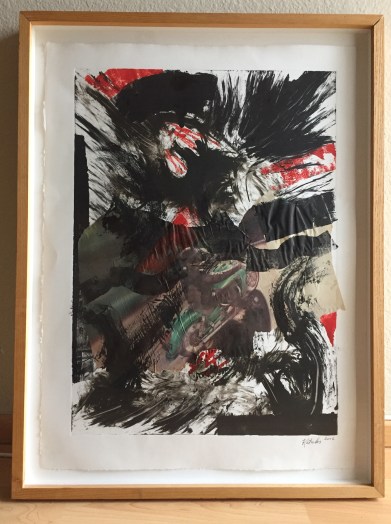
“Storm Hits The Sideshow” was the first painting I ever acquired. Famed acting teacher and director Milton Katselas painted it and the second I saw it in his art gallery, I knew I had to have it. As a matter of fact, I walked into his Saturday master class during a break, marched straight up to him, looked him directly in the eyes and said, “Milton, I love your painting, ‘Storm Hits The Sideshow’, and I must have it. I will own it.” And in true Milton fashion, he put one hand on my shoulder, looked me straight in the eyes and said, “Good!” That’s all he said and I knew that he knew the painting was going to be in great hands.
I purchased the painting a week later, and to this day, I still love it.
This is a work of art that inspires me and is personal to me. If you zoom into the picture of the painting, you will see a guy riding a motorcycle in the middle of this storm. I always saw myself as that guy. I am cutting through the storm, the uncertainty and the craziness of this industry. I am that guy on the motorcycle who is cutting through the ups and downs, the naysayers and the rejections with force and intention.
That guy on the motorcycle is stepping into the storm. He’s stepping into the fire to get to the other side. He is bypassing and pushing through any doubts, fears and considerations he has. I have no doubt that this guy will make it to the other side of this storm and into a place filled with sunshine, clear skies, rainbows and drag queens (Yes to RuPaul’s Drag Race!)
I know that I too am pushing through with intention, even when I don’t have all of the answers. Even when things look dark. Even when it looks like the storm will never end. Why? Because I can ask the next question. Because I am on go. Because I take specific actions for my career. Because I am surrounded by a great community of like-minded artists and friends. Because I am a motherfucking artistic force who knows this is what I want to do with my life. In this painting, there is no sense of where the storm begins or ends, but it doesn’t matter because I am creating and building my career one action at a time.
I would love to read your comments below about what inspires you! Is it a painting? A song? A movie? I would love to know!
I haven’t forgotten about you! I know, I know! The last time I wrote you an open letter was on July 15th, 2015. It was titled, “Sleeping With James Franco For 8 Months”. For those of you who are interested in reading that blog entry, here is the link:
Rest assured that I haven’t forgotten about you! I am implementing the next phase to seal this deal! And to make it up to you, here is a song I want to dedicate to you from “The Roar of the Greasepaint, The Smell of the Crowd”. Lyrics appear below the picture.
“Look at that face –
Just look at it,
Look at that fabulous face of yours.
I knew first look I took at it,
This was the face that the world adores.
Look at those eyes –
As wise and as deep as the sea.
Look at that nose –
It shows what a nose should be.
As for your smile, it’s lyrical –
Friendly and warm as a summer’s day –
That face is just a miracle.
Where could I ever find words to say.
The way that it makes me happy
Whatever the time or place?
I’ll find in no book
What I find when I look
At that face.”
A demo reel or a theatrical reel is a collection of short scenes that showcases your best work as an actor. It lets the viewer know what you’ve done, but more importantly, it shows them the kind of characters you can play. A reel can also be used in the voiceover world, the music world, the directing world, the producing world, etc.
The following are tips I have learned and applied for myself and have shared with others in my artistic community.
**Your reel should be concise and to the point for maximum impact. Your scenes should be 30-35 seconds max. Nobody will sit through a 5-minute, 7-minute, and in some cases I’ve seen, a 10-minute reel! Too freaking long! Trust that people are actually smart and intuitive. They get your casting and your ability to play the part in seconds. Each scene on a reel should give the person watching it just enough to leave them wanting more. Find the “heart” of the scene where you’re shining as your character, where we see the height of what’s going on, hook your viewer with that section and then move on to the next scene.
**Don’t use multiple scenes from the same episode or film in your reel. We already saw you as the U.S. Senator in “House of Cards” or “Scandal” in the beginning of your reel, so we don’t need to see you again as that same U.S. Senator later on in your reel. Similarly, if we already saw a clip of you as a detective from one show, we don’t need to see you playing five other detectives from five other shows on your reel. We got it the first time! You’re a detective! Are the other five detectives going to be vastly different from the first detective we saw? Don’t be redundant. Get to the point. Show us other castings. I think people do that to show off the number of credits they have. They want to show that they have been on numerous network shows or feature films. Remember: Quality vs. Quantity. Things will all look and sound the same if you put five detective scenes on your reel. Pick your best detective scene and let people go to your IMDB page to see the rest of your credits.
**Production value! If you’re just starting out and want to create your reel or if you’ve been in the business for a while and want to update your reel, you can generate your own material and shoot it yourself. Shoot it with high production value so that it can stand up to things that were professionally shot. And for me, production value includes:
Utilizing a great camera.
Utilizing great sound equipment.
Utilizing great lighting equipment.
Having a small crew of people who are proficient with 1, 2 and 3. Also, having a small crew that can assist in other areas such as production assistance, script supervision, a first AD, etc.
Writing a scene that puts you in your best, strongest light. A scene that brings out your great acting work. Going back to a scene being 30-35 seconds max, the rule of thumb is that one full page of text usually equates to one minute of screen time. So write a half page scene for your reel and keep the scene focused on you since it’s for your reel.
Rehearsing with your scene partner to carve out the performance.
Creating a simple, yet effective, shot list. Because this scene is for your reel and it’s to showcase you, a medium, dirty over-the-shoulder shot will do the trick! A dirty shot is a shot that contains some physical intrusion, usually in the form of a body part from another actor, like their shoulder, head, hand, leg or waist. The director may want to make the shot dirty to simply give a sense of distance between the two actors.–actinganswers.com
Here are two examples of a dirty over-the shoulder-shot:
(L-r) RALPH FIENNES as Lord Voldemort and DANIEL RADCLIFFE as Harry Potter in Warner Bros. Pictures’ fantasy adventure “HARRY POTTER AND THE DEATHLY HALLOWS – PART 2,” a Warner Bros. Pictures release.
This particular shot keeps us focused on you. It’s your reel. You’re the star. If you want to keep the shot static (where we don’t cut back to the other actor) then make the scene shorter. In this way, you lessen the risk of people losing interest in your scene since it has no one to cut back to. And because of the way the above shots are framed, you can set up a nice and simple production design in the background that gives us a sense of where we are.
**When you edit your reel, find the musical rhythm and flow of it. Is your first scene light and fun and then the rest of your reel alternates between dark and light scenes? Do you start your reel with something light and end it with something light? Do you have three procedural scenes next to each other that need to be broken up by a scene from a different genre? Depending on the scenes you’ve shot, you will arrange them on your editing timeline in a way that creates a musical rhythm and flow.
**As you play the scenes on your editing timeline, make cuts as needed. Going back to a scene being 30-35 seconds max, when you look at an entire scene you’ve shot, find the heart of the scene. Feel where the in and out points are in your 30-35 second clip. I’m really good at feeling the in and out points of a scene. As a dancer and as someone who loves music, I can feel where the scene should begin and where it should end. My body does this physical motion of when it feels the scene should begin and where it should end. I hope that makes sense LOL.
When I look at someone’s reel, I’m good at saying, “End the scene right there. Don’t go past that moment.”
So in last Sunday’s blog entry, “Yale + Harvard = ShondaLand?”, I shared with you all an assignment I received to read challenging material out loud for five minutes in the morning and five minutes at night for one full month. The objective was to train myself to pick up material cold, on the spot, and read from it with confidence and fluidity. This practice will help me with procedural auditions (cold readings in particular)
I decided to tackle articles from the Yale Law Review, the Harvard Medical Journal and the New England Journal of Medicine. I want these journals to be one of the tools I use to understand and get myself into a procedural world like ShondaLand.
Lord chile! I stumbled through all of the journals for the first fews days. I think I had a 70% success rate of ease and comfortability. The remaining 30% of challenge came from law and medical terms I was not familiar with. Or a series of large words that require effort and thought. Every time I stumbled, I would read the section over and over again until I nailed it.
DEFIBRILLATOR!
AORTIC!
UNILATERAL HUMANITARIAN INTERVENTION!
Critics of the criminalization of aggression adopt the same understanding of the internal normative posture of the law, but object to its classification alongside the other international crimes precisely because it privileges sovereignty over humanity. (Yale Law Journal. “Why Have We Criminalized Aggressive War?” by Tom Dannenbaum)
The cool thing I noticed was that I read each article as an actor. Meaning that even though I stumbled over unfamiliar words here and there, I still had a strong sense of storytelling. I understood setup and payoff with certain sections. I added emphasis in certain sections to drive a point home. I felt like I was delivering a speech to an assembled audience of doctors or lawyers and I wanted to make sure that my communication landed on them. That I was impinging them. That I was connecting to them.
One week down! Three more weeks to go! At some point, I’d love to film myself reading one of these articles cold and then sharing it with you all.
I recently did a cold read audition in class. I had 10 minutes to prepare for this procedural type material. I was playing a character who was one of the top heart surgeons in the city. I quickly started making strong choices, but I found myself tripping over the medical terms. I realized that procedurals are an area where I need more strengthening. By the way, “procedural” is a term used to describe a type of television series: medical, law, cop/detective.
I did my cold read on camera and it went very well. When I watched my audition and assessed my work afterwards, I said that I was happy with what I created in 10 minutes. However, I could see that my attention was on making sure that I delivered the medical terms correctly first and that my performance came second. I was more focused on getting the words right then focusing on my performance.
So my teacher, Richard Lawson, gave me an assignment. Actually, he gave the entire class an assignment. Over the next month, he wants us to pick up and read challenging material out loud for five minutes in the morning and five minutes at night. In this way, we build certainty and strength in picking up challenging material and reading it cold out loud.
Like anything else, it’s about the reps. It takes practice. Some people are just naturally at ease when it comes to procedural terminology. For others, like myself, it takes practice. If I go in for any procedural show like Scandal or NCIS New Orleans or Chicago Med, I need to be comfortable with saying their words in a clear and confident way. Picking up challenging material and reading it out loud for the next month is going to be very helpful.
So I decided to read articles from the Yale Law Journal and the Harvard Medicine Magazine. I’ll also read articles from The New England Journal of Medicine.
In a month, we’re going to do cold read auditions again and he’s going to give us sides from procedural TV shows. It will be great to see how much I improve in picking up challenging procedural sides and reading them cold with more certainty and confidence.
I recently met with a talented actor and friend to help them with his business plan-or DOIN’ as we call it at the Richard Lawson Studios. DOIN’ stands for Declaration of Independence. We only focused on his raison d’être (which literally means your reason for existence. Your reason for being.) In other words, purpose. What is your purpose as an artist and as a person? Why are you pursuing this particular career and not another one like law, medicine, etc.? We only focused on this part because the raison d’être is the engine that drives everything. It colors and influences everything that comes after it in your business plan.
It was great to hear his raison d’être and then ask the next question so that it could be a little more specific and personal to him. What he had already written down was great! I just asked questions to help him take it to a higher level of specificity and personal resonance.
And there was one part in his raison d’être that really struck me. He mentioned “sending down the elevator” to others when he reaches a certain level of success. “Sending down the elevator” meaning that he’s reached a high level of success and now wants to give back to others in the same way people have supported him in his journey. He wants to pay it forward to others who are just starting out, who need direction or help, etc. He took the elevator up to the top and now wants to send it down to others and help them make it to the top as well.
It’s interesting because I’ve heard this similar desire in others who have shared their raison d’être with me before. They too want to help and inspire others. And what I told my friend is that he can send the elevator down NOW. Through small, simple, meaningful actions of GIVE, he can help others now.
Now, as he becomes more famous or wealthy, his sphere of influence and give will increase. But he can take actions now. He loved that perspective and it opened up his eyes to the fact that he can give now. He’s excited in what he can do now to help others and I can’t wait to check in with him to see what actions he’s taking.
So, you don’t have to wait until you “make it” or become famous or rich in order to send the elevator down. Your raison d’être exists in you now. That’s what drives you every day to be who and what you are. So give now.
For those of you at home experiencing a similar situation as my friend, here are some simple, doable actions of give that I’m going to quickly throw out as they pop into my head:
Offer to help someone do their first scene in scene study class.
Offer to help someone with their film shoot by being a production assistant or first assistant director or running craft services, etc.
Support someone by attending their comedy showcase.
Help someone out with their audition.
Be a buddy or mentor to a new student in class and show them the ropes, the ins and outs.
Offer to help someone out at their headshot session.
Share someone’s weekly blog entries with your contacts and on your social media 🙂 🙂 🙂
Introduce someone to your agent or manager.
Introduce someone to your friends.
Volunteer at a shelter.
Donate money or time to charities.
Donate money to a fundraising campaign to help bring a person’s passion project to life.
Offer to listen and provide helpful advice.
If you see an opportunity for someone, let them know about it.
Go to the movies with someone.
Take someone out to lunch.
Share someone’s weekly blog entries with your contacts and on your social media 🙂 🙂 🙂
Write someone a note of thanks and appreciation.
Do research for someone in a particular area they need help with.
Donate items to someone’s yard sale.
If someone is looking to repaint or redecorate their room, offer help.
If someone needs help moving out of their old place and into their new one, offer help.
What other ways can you think of to pay it forward and give? I would love to hear from you in the comments section below!
I wanted to share some cool advice on what I do to maintain a healthy relationship with my agent. I hope this advice will be helpful to you!
Maintain consistent communication with your agent. You and your agent can determine the frequency with which you both communicate because each agency is different. Also, find out what their preferred method of communication is (email, text, phone call, in person) In my case, it’s through email.
Please know that agents are incredibly busy people, so make sure that your communications are clear, to the point and not filled with filler and bullshit. Don’t waste your time, don’t waste their time. Make the communication effective and business-focused. This is your agent, not your best friend from college. The communication should be about something that can move your career forward (e.g., you signed up for a new improv class; you are taking new headshots; you updated your reel and are providing a link for them to watch it; you are taking a casting director workshop; you took a casting director workshop and you are providing your agent with quotes that the casting director said about you; you are reaching out to see what materials they need from you, etc.)
Use communication to work together towards the realization of your dreams. Is there a series you’re passionate about and can see yourself on? Let your agent know and have them keep their eye out on the casting breakdowns for that series and possible characters on it that they can submit you for. If your agent knows you’re passionate about a series, then their attention will be on it. They may even encourage you to target the series as well!
Return their communications in a timely manner. Don’t have them chase after you. If they ask you to do something that could benefit your career, consider it and do it. The relationship between you and agent is a dance partnership. Present your viewpoints and listen to their viewpoints. Fight for the stuff you believe in and consider their ideas as well. Be open and “yes, and…” The cool thing about this dance partnership is that when you first interview with an agent, be clear about what you want for your career and how this partnership can support that. Be clear about what you want from jump street so that all communications and actions can be in support of your dream.
Update your materials on a consistent basis and send to them. Headshots, reels, etc. In addition, email them auditions you’ve done in your on-camera audition class. Email them links to projects you’re in. In this way, you’re giving your agent tools that they can work with and pitch you with. In addition, they’ll also see that you’re active about your career. Keep them excited and invested in you by involving them in your journey. Make the effort to stay in their minds.
Be in a good acting class to continue training and growing as an actor. Scene study, improv, on-camera audition class, etc. I don’t care what it is. Be in class and stay sharp.
Be prepared for the auditions you are sent on. Prepared from confirming the audition with your agent to knowing what the project is about to being off book to getting there on time to sending thank you cards to the casting directors afterwards, etc.
Be enthusiastic about your career and be committed to it! If they see that you are enthusiastic and committed to your career, then they will be more inclined to go to bat for you and prolong the business relationship longer.
Thank them for the work they do for you! Whether it’s in the form of words or gifts, appreciation goes a very long way! Agents do a lot of work and don’t get paid until their clients book work. Show them that you appreciate them. Thank them every time they secure an audition for you. Thank them for going through the casting breakdowns every day for you. Appreciation goes a very long way!
Understand that we have to do the majority of the work in this business relationship. It’s your career and so it’s your responsibility to put in the hours and work. Don’t rely on your agent to do it all for you. That’s not how this works.
Leave me a comment and share what you do to maintain healthy relationships with your agents! I’d love to read them and possibly implement them as well!
Okay! So you’ve had a successful headshot shoot. Hooray! Congratulations! You did it and you’ve celebrated all the hard and fun work you put into having a wonderful headshot shoot experience.
So, now what?
Depending on the photographer you’ve shot with, the length of time you spent shooting with them, the number of characters you shot, etc., you could end up with anywhere from hundreds of shots to choose from to over a thousand to choose from.
For a lot of actors, this is an agonizing process. How do I choose my favorite shots out of hundreds? Out of thousands? YIKES! YIKES! YIKES! The horror! The stress! Bite your fingernails, tear your hair out, run to a corner and sob violently!
“Not today, Satan, not today!” (Thank you Bianca Del Rio for creating that phrase!)
Actually, this process doesn’t have to be agonizing or painful. It doesn’t have to consume weeks of your life. Choosing your favorite shots can be a very easy process.
I want to share with you my process for how I made my final selects from the headshots I took on February 25th.
1) I go through each photo with a forward and intentional pace. I don’t linger on each photo for five minutes. Move with intention because the photos will either hit me on a gut level or not. Our instincts are incredibly powerful. We know what we know. A photo either hits me or it doesn’t. Those that hit me, I move them over to a new folder. I continue this process until I get to the last photo. Once I get to the last photo, see number 2.
2) I repeat the process to see if there are any other possible photos that hit me on a gut level.
3) I go to the new folder and call it “Selects”. I then go through each photo a little more carefully and make note of things that would disqualify the photo from making it into my final selects. For example, is the photo blurry? Do my eyes look a little dead in the photo? Is there a shadow across my face that maybe can’t be fixed in Photoshop? Am I blown out? I go through this folder to examine mistakes.
4) I weed out the photos that contain mistakes and I’m left with 56 photos in the “Selects” folder (By the way, we shot a total of 463 photos.) I go through the 56 photos to start narrowing down my personal favorites. I look at the subtext of my characters. I look for a secret in the characters’ eyes. Whenever I choose a favorite photo, I tag them (I work on a Mac, so I right click on the photo file name and choose “Tags”. Then, I choose a color to go next to the file name. I chose red.) The photos I don’t tag as my personal favorites are still kept in the “Selects” folder because they are still strong contenders and I want to have options to present to my community and to my agent. They may see something I don’t see. Once I’ve tagged my personal favorites, see number 5.
5) I present these 56 photos to my small group of classmates (These are people I trust and respect.) It’s important not to have too many cooks in the kitchen because you will only become confused!!! So find a handful of people you trust to share your photos with. When I presented my photos and went through each one, I took note of the photos that received the biggest reactions. If my community was responding powerfully to certain photos, then those were keepers and I later tagged them in red as well (and it was nice to see that my class and I matched on several photos I already tagged.)
Now, for the photos I already tagged as a personal favorite, but didn’t receive as big of a reaction as others, I looked them over to see why they didn’t impinge my classmates. I ended up removing 4 personal favorites from the “Selects” folder. So now, I have 52 photos left in this folder. Again, some are tagged as my personal favorites, while the rest are un-tagged photos that are still strong contenders.
6) I sent the 52 photos to my agent to see which ones he liked. When he emailed me his list of favorites, I tagged them in a different color. I chose blue. And it was great to see that he and I matched on several photos. He also chose a few photos that I didn’t tag as a personal favorite. However, I took those photos into consideration because his job is to field the entertainment market place 24/7. He knows what’s out there. He knows what’s selling and what’s being bought. I want this to be a collaboration between the two of us and include his picks as well.
7) The photos where he and I matched (Red and blue tags) were definite keepers. For the photos where he and I didn’t match, I chose a few photos that had a blue tag (his personal favorites) and a few photos that had a red tag (my personal favorites) In this way, I’m including both of our personal favorites and respecting both of our opinions. I create a final folder called “Winners” and put these final photos in it.
And that’s it! A pretty easy, painless process!
I have 20 photos that I will upload across Actors Access, LA Casting, IMDB, etc.
On August 22nd, 2015, I celebrated 13 years of living in Los Angeles! 13 years!
It feels like yesterday that I was still living in Brooklyn with my mom. I was at a real crossroads in my life. After 9/11, I knew that life was too short. And I knew that if I wanted to pursue film and TV fully, that LA was where I needed to be. I was so determined to get to LA, that I purchased a one-way airline ticket and didn’t tell my mom that I was moving until three weeks before my scheduled flight. She was so shocked that I gave her such little notice, but I had to make sure that no one, and I mean no one, had time to change my mind.
And in taking all of yesterday to reflect on and to celebrate the last 13 years, one theme emerged. As Madonna said above at the end of her 1995 music video for “Human Nature”: “Absolutely no regrets.”
I have none. I could easily have spent all of August 22nd lamenting all the losses and disappointments, both real and perceived, that I’ve had in the last 13 years. After all, 13 years is a fucking long time and anyone could easily fall into the dark side of regrets and the dark side of the woulda, coulda, shoulda: I could have worked more as an actor, I should have worked more as an actor, I should be at a better place in my life right now, I should have done this sooner, I should have learned that lesson earlier, if I only I knew back then what I know now, etc. But what a waste of time and energy that is.
Again, absolutely no regrets. I’ve never been one to look back…not for too long at least. There’s nothing I can do to change the past. I can only focus on today and how to make it count.
I spent yesterday celebrating how much I have grown as a person and as an artist. Celebrating the fact that I am STILL in the game and that I haven’t given up. I recently saw some pictures of people I went to college with on Facebook and I was shocked by how much some of them have aged. Aged because they gave up on their dreams. They lost that fire, that spark, that thing that made them youthful. That spirit left and life settled in. They are doing other things with their lives now. No judgments. I cast no
judgments. I’m just making an observation. People that I used to have a crush on in college have aged badly or gained so much weight. They’ve let themselves go. Meanwhile I, who used to be so awkward looking in college, have continued to age beautifully both inside and out. I still feel like a big kid sometimes. I’m still connected to my dreams. I still act, I still write, I still dance. I’m surrounded by a fantastic community of mentors and artists who keep me alive, vibrant and focused. Always have since 2002. Always will until the day I die.
When I first landed in LA, I broke down in tears at LAX. Shit just got real. I arrived. There was no turning back now. I came with one suitcase and a leather CD book containing 200 CD’s. I only knew one person out here. I had no job lined up. I had no apartment lined up. I had no family out here. All I had was my faith and determination that things would all fall into place.
And taking a line of dialogue out of the Madonna mythology, I got into a taxi and said, “Take me to the center of everything.” In the Madonna mythology, she arrived in NYC in 1977 with $35 in her pocket. She told the taxi driver to drop her off in the center of everything. So, he dropped her off in Times Square. My taxi driver dropped me off in
Beverly Hills. Now, I know some of you may be laughing, but the universe was quickly working in my favor. The taxi driver dropped me off at an Enterprise Rent-A-Car on Robertson Blvd., one block south of Wilshire Blvd. Little did I know that located just a couple of blocks south of Enterprise Rent-A-Car was the place that would become my second home for the next seven years, the Beverly Hills Playhouse.
I got my rental car and drove away. I turned on the radio and the first song I heard in LA was Kylie Minogue’s “Love At First Sight”. I’ll never forget that. It was a beautiful, clear, sunny day. I was vibrating with excitement. The only person I knew out here was a buddy of mine who I used to work with at a dance club in Manhattan. He was out here with his twin brother on business (I would later discover that their “business” was the escort business and they were marketing themselves as 2-for-1 all-American blond twins!)
They were renting a room at the Ramada Plaza West Hollywood. He said I could stay with him and his brother until I got my own place to live. Twenty four hours later, he got me an interview with the front desk manager and I got hired. I started work a few days later. The universe was taking care of me. Within a week, I found a place to live in West Hollywood. The universe was taking care of me again.
My second day in LA, I ran into someone I graduated with from Vassar. I told him I moved to LA to pursue acting and he immediately recommended the Beverly Hills Playhouse (which is where he was studying) I called the BHP to schedule an interview. They accepted me and I began classes in the first week of September. I sat in the front row, on the edge of my seat, eager to learn and to be inspired. I could feel a palpable energy in the room that I have never felt before in a class (acting class or otherwise) When Gary Imhoff first walked into the room, the class cheered and gave him a standing ovation. I wasn’t expecting that at all!
I don’t remember if I stood up and cheered as well or if I remained in my seat. But what I DO remember was that as soon as Gary settled into his seat, I leaned back into my seat and I said to myself, “This is my teacher. This is my home.” I just felt it in my heart and in my gut. After the first day of class ended, I walked north on Wilshire Blvd. and saw the Enterprise Rent-A-Car! I immediately became emotional because I knew that the universe was taking care of me. It was a cool moment of experiencing something coming around full circle.
Everything was falling into place. LA was new and exciting. The weather was great. Palm trees galore. I had a place to live. I had a Plan B job supporting my Plan A game. I found an amazing second home at the Beverly Hills Playhouse. Kelly Clarkson was crowned the first American Idol on September 4th, 2002 (and honestly, her win was the only one that truly mattered) Then, within a month, I hated LA. And I would end up hating LA for the first year because I experienced everything from home sickness to hating public transportation to hating that nothing was 24/7 like in NYC. It wasn’t until I got my first car around my first year anniversary, for FREE, that I fell in love with LA. Having a car really turned my feelings around.
13 years later and I still love LA. LA is my home. I’m part of that very small percentage of New Yorkers who love LA and prefer it to NYC. When I fly into LAX, I always feel good to be back home.
Absolutely no regrets. I don’t regret calling every single agent in the agent book in 2002 to receive representation. I don’t regret walking into casting offices to drop off my headshot and resume. I don’t regret any career administration I’ve executed. I don’t regret putting one foot in front of the other. I don’t regret any scenes I’ve put up in acting class in the last 13 years. I don’t regret the personal and professional choices I’ve made. I don’t regret the people I cut out of my life in order to pursue my career. I don’t regret the people I cut out of my life who were not part of my career bus. I don’t regret the friends I’ve made and the friends I’ve lost. I don’t regret all the times I’ve danced in stores, supermarkets, beaches, streets, subway platforms, trains, bus stations, parks, etc. I don’t regret all the times I ran lines to myself in public places. I don’t regret all the times I rehearsed a scene in public with my various scene partners. I don’t regret rehearsing the diner scene from “Biloxi Blues” at the Silver Spoon Diner in West Hollywood and causing such a mess with my amazing scene partner that management banned us forever. Ironically, the Silver Spoon Diner is no longer around, but I am 🙂
I’m still here! I’m still in the game! Yesterday was a celebration of all the good things I have experienced here in LA. A celebration of all the wins and all the growth I’ve experienced. I started my day by doing DanceFitWalk at the Rose Bowl at 8am. I danced my ass off for an hour and a half with my DFW team. Then, I went home and showered and went to the beach to not only celebrate my anniversary, but to join a friend who was celebrating her birthday at the beach as well.
Then, I went to a restaurant and had an early dinner. Then, I bought champagne and put it in the fridge. And then, I ended the night dancing away with a cool friend I’m getting to know.
Celebrating these 13 years was about joy and happiness!



 Chasing The George